Endurance athletes are often told to avoid the weight room, or to stick with light weights and high repetitions so they do not get “bulky” or slow. The research says otherwise. Heavy strength training and speed and power work can make runners more efficient, and they do not have to cost you your engine.
There is a catch, though, and it is one that headlines like “lift heavy” tend to skip. Strength training is a skill. You earn the right to lift heavy by learning how to move well first.
This post covers what the research says, why speed and power work belongs in a runner’s week, and how to bring both in safely.
Does Strength Training Actually Make Runners Faster?
Mostly yes, and the main reason is not bigger muscles or a bigger engine. It is efficiency.
Running economy describes how much oxygen you use to hold a given pace. Two runners with the same VO2max can perform very differently if one of them spends less energy at race pace.
A 2008 study by Støren and colleagues had well-trained runners add eight weeks of heavy half squats (four sets of four repetitions, three times a week) to their normal running. Running economy improved by about 5%, and time to exhaustion at maximal aerobic speed improved by 21.3%. VO2max and body weight did not change (Støren et al., 2008).
A systematic review of 24 studies found that strength training generally improved running economy by 2 to 8% compared with running alone, though not in every study (Blagrove et al., 2018). A separate meta-analysis in highly trained runners reached a similar conclusion (Balsalobre-Fernández et al., 2016).
These gains come without a change in VO2max. You are not building a bigger engine. You are helping the one you have use less fuel.
Why Heavy?
Heavy lifting trains your nervous system to recruit more muscle fibres, and to do it more efficiently. You can get stronger without getting much bigger. Each stride then costs a smaller percentage of your maximum strength, so the same pace feels easier.
Load matters. A 2022 meta-analysis of long-distance runners found a small benefit to running economy from heavy resistance training, while plyometric training on its own had a trivial effect. Programs using loads near 90% of one-rep max showed greater effects than lighter loads (Eihara et al., 2022). A 2024 meta-analysis found that high-load strength training improved performance in middle and long-distance runners, and that combining methods may help more (Llanos-Lagos et al., 2024).
One caution: the studies above enrolled runners who were already trained and, in most cases, comfortable with the lifts. They tell us what heavy loading can do once someone is ready for it. They do not tell a beginner to start there.
Strength Is a Skill: Build the Foundation First

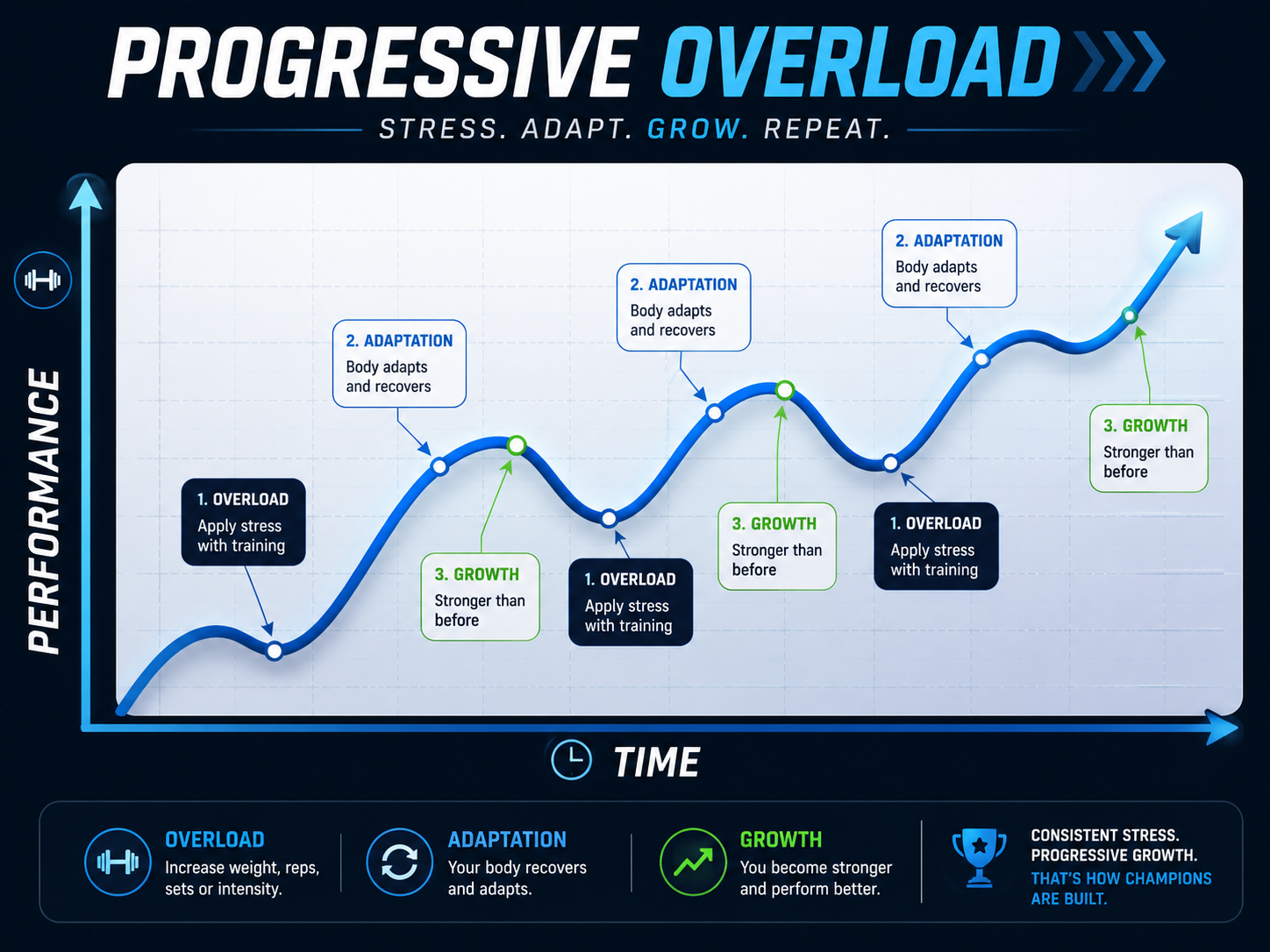
If you are new to lifting and cannot yet hinge, squat or lunge with good control, we are not loading you heavy. Lifting heavy before you can move well is how people get hurt, and how they end up with technique habits that are hard to undo.
This is what we call the general physical preparedness phase. It is usually higher volume and lower load, and its job is to build capacity: learning the fundamental patterns, strengthening tissues that have not been loaded much, and building the work capacity to handle harder training later.
How long this takes depends on the person. In my experience, a true novice usually spends two to three months here, but it can stretch to five or more, especially if we only see each other once a week. That is a coaching observation, not a research finding. Frequency, previous training history, and how quickly movement quality develops all change the timeline.
Once the movements are solid, the weight goes up and the repetitions come down. Someone with a lifting background can reasonably get there much sooner. The standard is not a calendar date. It is being able to perform the main patterns with control, consistently, under fatigue.
What About Speed and Power?
Strength is only part of what a running stride asks of you. Your foot is on the ground for a fraction of a second, which is far less time than a heavy squat takes. Rate of force development (RFD) is how quickly you can produce force, and power work trains that.
In a well-known study, Paavolainen and colleagues had endurance athletes replace part of their training with explosive work, including sprints, jumping drills and fast leg press and knee extension exercises, for nine weeks. Their 5 km time, running economy and maximal speed on a treadmill running test improved, while a control group that only did endurance training saw no change. VO2max did not change in the explosive group (Paavolainen et al., 1999). The sample was small (10 vs. 8 athletes), so treat it as supportive rather than final.
A review by Rønnestad and Mujika (2014) agreed that combining endurance training with either heavy or explosive strength work improves running economy. Proposed explanations include better neuromuscular efficiency and greater musculotendinous stiffness. Our post on dorsiflexion in plyometric training goes deeper on how the ankle works like a spring.
Power work does not have to start with anything complicated. Snap downs and med ball slams are introductory drills that teach you to produce force quickly and with intent. From there, we can progress to pogos, skipping, box jumps, broad jumps and other plyometrics as your landing mechanics and tissue tolerance allow. If you run trails, our post on strength training for trail running covers how this applies to climbs and uneven terrain.
Won’t Lifting Make Me Bulky or Slow?
The research on runners suggests this worry is largely unfounded. In the Støren study, body weight did not change, and running economy improved without a change in VO2max (Støren et al., 2008).
Muscle gain depends on training volume, nutrition and total energy intake. A few heavy, low-repetition sets alongside high running volume is not a bodybuilding program.
The bigger risk is the opposite one: stacking hard lifting on top of too much hard running without enough recovery. That is a programming problem, not a reason to avoid lifting.
Does Lifting Prevent Injuries?
This is less clear than people claim. A large review of exercise interventions found strength training was the most effective single intervention for reducing sports injuries overall (Lauersen et al., 2014), but that review covered many sports, not only running.
For runners specifically, the evidence is mixed. I would not promise that lifting will keep you injury-free. What I will say is that stronger tissues tolerate load better, and that supervised, well-progressed training is a sensible way to build that tolerance.
Principles for Applying This
Learn the movements before you load them
Technique comes first. If you cannot hinge, squat, lunge and brace well at light loads, more weight will not help you. Build the foundation, then progress.
Start the session with speed and power
When we train this, I usually begin with speed and power work, then move into heavy lifting, then accessory work. Power needs a fresh nervous system. If you try to jump or throw after a hard set of squats, quality drops, and quality is the point of those drills. This is session order. It is separate from the long-term progression above, which still moves from foundation to heavier loading as you get ready for it.
Keep the aerobic base the priority
Strength and power work supports endurance training. It does not replace it. Keep most of your running easy while you develop your aerobic base, and use strength work to complement it. If time is tight, two sessions a week is a realistic starting point, and intensity and consistency matter more than frequency (see our post on whether two days of strength training is enough).
Key Takeaways
• Strength training improves running economy, often by roughly 2 to 8%, without raising VO2max.
• Heavy loading shows larger benefits than light, high-repetition work, but the studies mostly involved trained runners who were already ready for it.
• Strength is a skill. Novices need a general physical preparedness phase to learn the movements and build capacity before lifting heavy, and that can take months.
• Speed and power work trains how quickly you can produce force. Snap downs and med ball slams are good starting drills, with pogos, skipping, box jumps and broad jumps to follow.
• Injury prevention evidence for runners is mixed. Expect better load tolerance, not a guarantee.
• In a session, power work generally goes first, then heavy lifting, then accessories.
Work With Avos Strength
If you are a runner in Vancouver wondering how to fit strength and power into your training, get in touch and we can build a plan around your goals and race calendar.
References
Balsalobre-Fernández, C., Santos-Concejero, J., & Grivas, G. V. (2016). Effects of strength training on running economy in highly trained runners: A systematic review with meta-analysis of controlled trials. Journal of Strength and Conditioning Research, 30(8), 2361-2368. https://doi.org/10.1519/JSC.0000000000001316
Blagrove, R. C., Howatson, G., & Hayes, P. R. (2018). Effects of strength training on the physiological determinants of middle- and long-distance running performance: A systematic review. Sports Medicine, 48(5), 1117-1149. https://doi.org/10.1007/s40279-017-0835-7
Eihara, Y., Takao, K., Sugiyama, T., Maeo, S., Terada, M., Kanehisa, H., & Isaka, T. (2022). Heavy resistance training versus plyometric training for improving running economy and running time trial performance: A systematic review and meta-analysis. Sports Medicine - Open, 8, 138. https://doi.org/10.1186/s40798-022-00511-1
Lauersen, J. B., Bertelsen, D. M., & Andersen, L. B. (2014). The effectiveness of exercise interventions to prevent sports injuries: A systematic review and meta-analysis of randomised controlled trials. British Journal of Sports Medicine, 48(11), 871-877. https://doi.org/10.1136/bjsports-2013-092538
Llanos-Lagos, C., Ramirez-Campillo, R., Moran, J., & Sáez de Villarreal, E. (2024). The effect of strength training methods on middle-distance and long-distance runners’ athletic performance: A systematic review with meta-analysis. Sports Medicine, 54(7), 1801-1833. https://doi.org/10.1007/s40279-024-02018-z
Paavolainen, L., Häkkinen, K., Hämäläinen, I., Nummela, A., & Rusko, H. (1999). Explosive-strength training improves 5-km running time by improving running economy and muscle power. Journal of Applied Physiology, 86(5), 1527-1533. https://doi.org/10.1152/jappl.1999.86.5.1527
Rønnestad, B. R., & Mujika, I. (2014). Optimizing strength training for running and cycling endurance performance: A review. Scandinavian Journal of Medicine & Science in Sports, 24(4), 603-612. https://doi.org/10.1111/sms.12104
Støren, Ø., Helgerud, J., Støa, E. M., & Hoff, J. (2008). Maximal strength training improves running economy in distance runners. Medicine & Science in Sports & Exercise, 40(6), 1087-1092. https://doi.org/10.1249/MSS.0b013e318168da2f