avos strength

What Actually Happens During an Initial Assessment?

Written by Evelyn Calado, MKin, CSCS, RKin

If you’ve ever hesitated to start training because you didn’t know what to expect from that first session, you’re not alone. At Avos Strength, we treat the initial assessment as one of the most important parts of the entire training process. Not because it’s a test, or something you can pass or fail, but because it lays the foundation for everything we do moving forward. It’s how we get to know you, your goals, your movement, and how we can best support you.

Here’s what actually happens during an initial assessment with us.

It’s a 55 Minute, One-on-One Session

Most initial assessments are done in person. We also offer virtual options for remote clients. Whether we’re working with you at the gym or through a screen, the goal is the same: get a clear picture of where you’re at so we can build something that’s right for you.

It Starts With a Conversation

Before we even get moving, we sit down together and go through your intake form. And yes, it’s detailed. We ask for it to be completed at least 24 hours in advance because we actually review it before the session.

We go over:

  • Your injury history and relevant medical conditions

  • Sports background, hobbies, and training experience

  • Your goals, both short-term and long-term

  • Any current pain, discomfort, or limitations

  • Your preferred training setup (in-person, hybrid, remote)

This isn’t just a checklist. It’s a conversation. We want to hear your story, understand what brings you in, and talk about how we can help. That also includes discussing which coach might be the best fit, based on your needs and our availability.

Movement Screen and Table Assessment
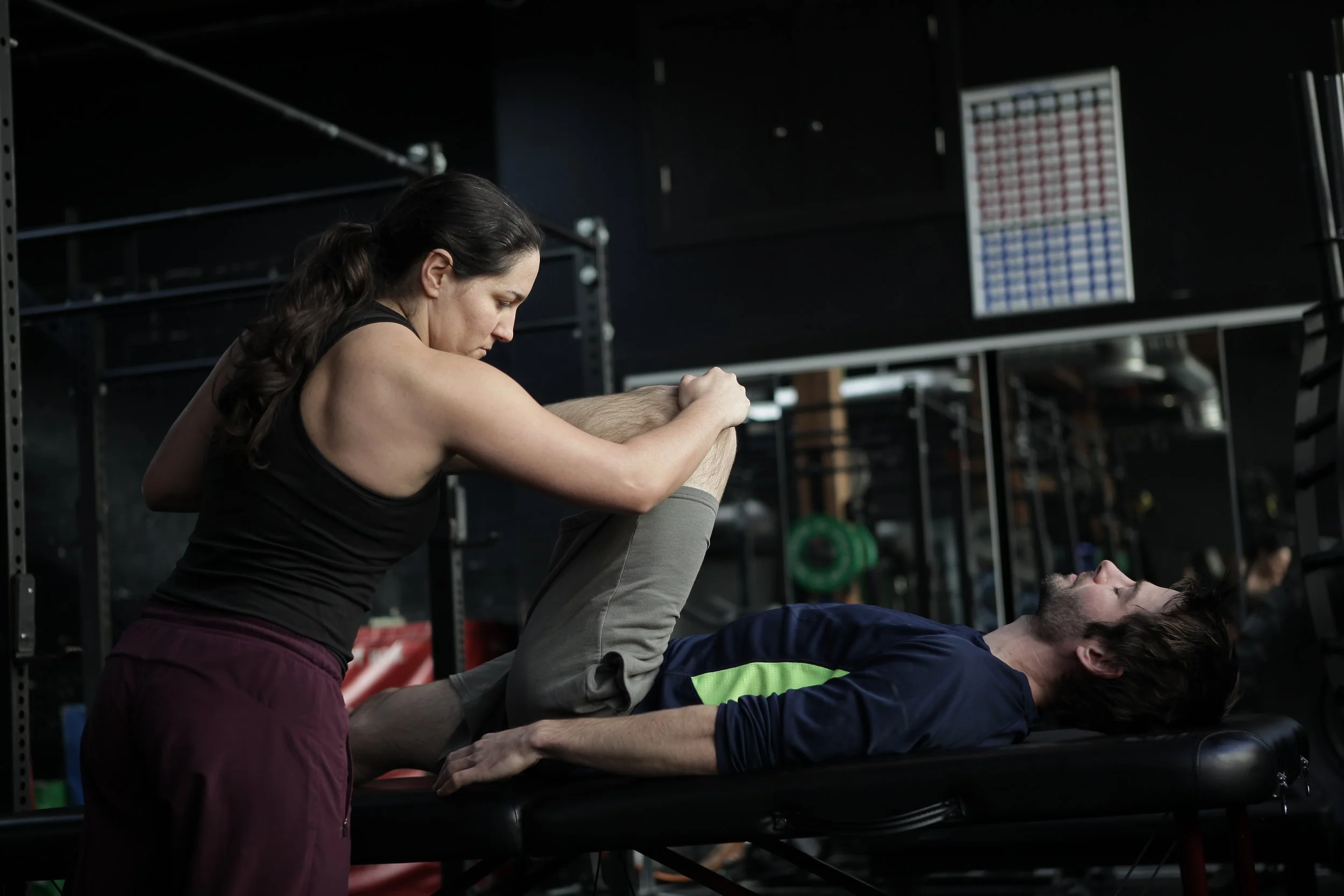
Table assessment being performed during an initial assessment at Avos Strength

After the consult, we begin assessing movement.

We typically look at:

  • Posture and gait

  • Basic functional movements (like squats, toe touches, and rotation)

  • Joint mobility and range of motion on the table

This gives us an idea of how you move in space, where you may feel limited, and what patterns we should be aware of when designing your program. For remote assessments, this part is adapted as best we can based on your space and setup.

This Is Not the Avos Performance Battery

Our initial assessment is different from the Avos Performance Battery, which is a full 90 minute performance testing session that includes a written report. This assessment is about gathering foundational information, not performance metrics. It’s the first building block in your training process, not a test.

What Happens With the Remaining Time?

Depending on how the session flows, we may use the last 10 to 20 minutes to go through some light drills, address pain points, or suggest a few exercises to get you started.

Sometimes we’ll do a bit of strength or movement testing, just enough to give us some useful data without overwhelming you on day one.

Why We Do It This Way

Your initial assessment helps us:

  • Build rapport and trust

  • Understand how you move

  • Identify restrictions or red flags

  • Gather everything we need to design a personalized program

Without this step, we’d be guessing. And that’s not how we operate. Your coach takes the time before, during, and after this session to make sure we’re starting from the right place.

How You Should Feel After

You should walk away feeling heard. You should feel supported. Ideally, you feel excited, not nervous, to start training and build something that’s going to serve you long term.

Training is a skill. It’s a habit. It’s a way of taking care of your body so you can keep doing the things you love, whether that’s playing sports, being active with your family, or just moving better every day.

Common Misconceptions We Hear

“I feel like I’m being judged.”
You’re not. There are no wrong answers in this process. If your hips move a certain way, or your shoulder is limited, that’s all information we use to help you.

“I don’t think I’m fit enough to be assessed yet.”
That’s exactly why we do assessments. You don’t need to be fit. This is about meeting you where you are and giving us a starting point to work from.

“What if I fail?”
You can’t fail. This isn’t a test. It’s a snapshot of where you’re at today.

A Structured, Individualized Approach

Everything we collect goes into your client file, not a generic template. Your program is built from the ground up based on your movement, your goals, your limitations, and your training setup.

Every Avos coach follows this system. Our junior coaches go through a structured mentorship before ever leading assessments on their own, and we continue to support them with feedback and review to maintain high standards.

There are no shortcuts. And that’s the point.


The first session isn't about being perfect. It's about getting started the right way; with a coach who sees you, listens to you, and builds something with you.

If you're ready to take the next step, explore our training options to find the approach that best fits your goals.

How to Train Like a Pro Without Overtraining: 3 Conditioning Mistakes Every Fighter Makes

Written by Evelyn Calado, MKin, CSCS, RKin

“You’re in shape… until you aren’t.”

Every boxer knows the feeling. You think you’re in shape, you’re sparring well, and then by Round 2 your legs feel like concrete. The problem isn’t effort. It’s the wrong kind of conditioning.

In combat sports, the difference between being fit and being fight ready is small but critical. Fighters often equate exhaustion with improvement. But fatigue is not the goal. The goal is to develop a system that lets you recover, repeat, and stay sharp under stress.

True conditioning teaches your body how to sustain power and recover faster between bursts. It builds the capacity to deliver the same output over and over without falling apart technically.

Mistake #1: Living in the “No-Adaptation Zone”

Most fighters train at one speed all the time. The intensity is too high to truly build aerobic qualities, yet not high enough to improve anaerobic power. This middle zone feels hard but does not create meaningful adaptation.

Training in this gray area leaves you constantly tired without improving the key factors that drive endurance. The aerobic system is the foundation for every other energy system. It is what allows you to recover between flurries, maintain composure, and control your pace.

When the bulk of training sits around 80 to 85 percent of maximum heart rate, the heart and muscles are working, but they are not being pushed to develop either side of the spectrum.

Fix:
Include one dedicated aerobic session each week. Keep the effort at a comfortable but steady pace where you can still breathe through your nose.

  • 25 to 30 minutes at 65 to 75 percent of maximum heart rate, or RPE 4 to 5.

  • Use light jogging, a spin bike, or shadowboxing flow work.

These lower-intensity sessions build the foundation that makes every other type of conditioning more effective later in camp.

Mistake #2: Mistaking Fatigue for Progress

If every session leaves you completely drained, you are not building capacity, you are burning it.

Fatigue by itself does not equal progress. When you constantly push to exhaustion, your coordination drops, timing slows, and recovery between rounds suffers.

Conditioning should improve the ability to produce high effort repeatedly, not the ability to survive pain. The aim is quality effort, not constant exhaustion.

Fighters often overload glycolytic, or medium-duration, efforts. They push too hard for too long and never develop the shorter, high-power system or the longer aerobic system that supports it. The result is a strong first thirty seconds and then a quick drop-off in speed and output.

Fix:
Introduce short, high-quality power intervals that target your explosive energy system.

  • Perform 8 to 10 seconds of all-out work such as a bike sprint, heavy bag flurry, or sled push.

  • Rest for 80 to 100 seconds at an easy pace before repeating.

  • Complete 6 to 8 total efforts.

These efforts improve maximal power and nervous system efficiency while allowing full recovery between reps.

Mistake #3: Ignoring the Aerobic Engine

The aerobic system is what keeps fighters explosive through multiple rounds. It is also what allows the body to recover between rounds and between training sessions.

Aerobic training does not make a fighter slow. It develops the internal engine that supplies energy to every burst and every exchange. A well-developed aerobic system improves the ability to replenish ATP, clear hydrogen ions, and use lactate as a fuel source during sustained work.

The common idea that fatigue is caused by lactic acid buildup is outdated. Lactic acid does not actually accumulate in the muscles. Instead, it separates into lactate and hydrogen ions, and the resulting increase in acidity contributes to fatigue. Aerobic training improves the body’s ability to manage that acidity and maintain performance over time.

Fix:
Use structured aerobic capacity intervals once or twice a week.

  • Work for 2 to 3 minutes at 80 to 90 percent of maximum heart rate or RPE 6 to 7.

  • Recover actively for 2 to 3 minutes until your heart rate drops below 130 beats per minute.

  • Repeat 4 to 6 rounds.

This type of interval work develops both delivery and utilization of oxygen, helping you stay relaxed and efficient even at higher outputs.

Why Smart Conditioning Wins Fights

The best-conditioned fighters are not always the ones who look the fittest in training. They are the ones who can stay calm, explosive, and efficient no matter how chaotic the fight becomes.

That calmness is a physiological skill. It comes from balancing the aerobic system that drives recovery, the anaerobic system that fuels sustained power, and the alactic system that supports short, explosive actions.

Smart conditioning develops all three systems in the right sequence and with the right intent. Build the base first, layer power on top, and taper the total load before competition.

Train Systems, Not Just Willpower

The difference between being in shape and being ready to fight is not about effort, it is about precision.

Conditioning should make you faster, more efficient, and more durable. It should leave you confident that your body can keep up with your skill. Hard work matters, but only when it builds something specific.

“Hard work is only as good as what it builds.”
— Joel Jamieson

Take the Guesswork Out of Your Conditioning

Knowing what to train is only half the battle. Knowing when and how to train each energy system is what separates a well-conditioned fighter from a tired one. A structured plan designed around your schedule, fight calendar, and current fitness level turns theory into progress.

If you’re serious about improving your fight conditioning, click here to explore our custom programs for fighters— designed to help you train smarter, recover faster, and perform your best when it matters most.

References

  • Jamieson, J. (2009). Ultimate MMA Conditioning.

  • Bott, C. (2023). Uncovering Limitations in Work Capacity.

  • Robergs, R. et al. (2004). “Biochemistry of Exercise-Induced Metabolic Acidosis,” American Journal of Physiology.

  • Brooks, G. et al. (2005). Exercise Physiology: Human Bioenergetics and Its Applications.