movement assessment

The Limb Arc Model: Why You Should Train the Range of Motion You Actually Own

Written by Evelyn Calado, MKin, CSCS, RKin

If you’ve ever wondered why:

  • Your knees cave in at the bottom of a squat

  • Your low back extends when the weight gets heavy

  • One hip always feels “stuck” at 90°

  • Or mobility drills don’t seem to transfer to strength

…you’re probably running into a concept explained by the Limb Arc Model.

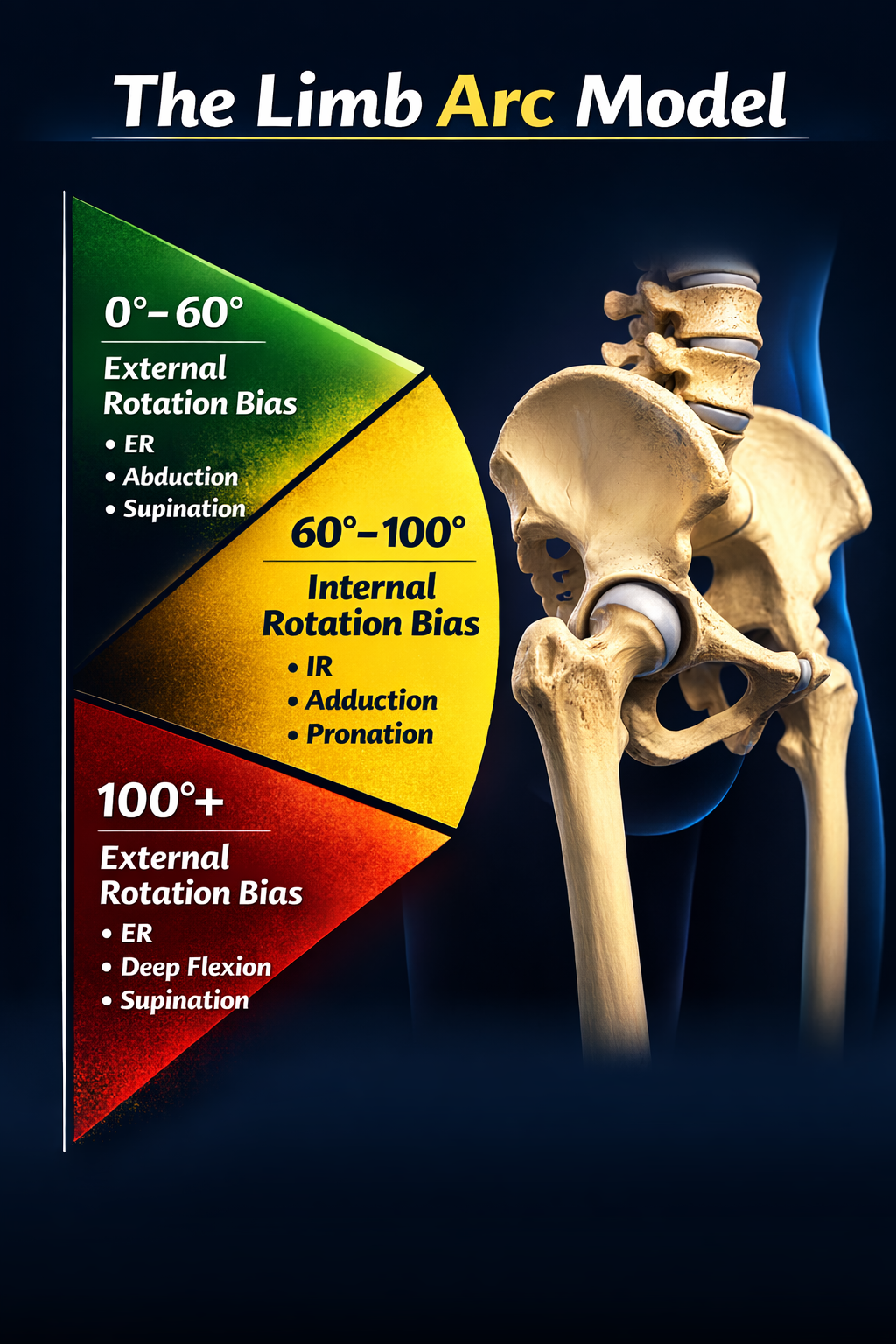
This model, commonly attributed to Bill Hartman, describes how rotational bias changes across ranges of joint flexion — particularly at the hip. And once you understand it, exercise selection becomes dramatically more logical.

Let’s break it down.


What Is the Limb Arc Model?

The Limb Arc Model proposes that rotational leverage changes as a joint moves through flexion.

At the hip specifically:

  • Early flexion favors external rotation (ER)

  • Mid-range flexion favors internal rotation (IR)

  • Deep flexion returns to an external rotation bias

This is not arbitrary. It reflects changes in joint geometry, length tension relationships, and moment arms.

Most people train hip flexion as if it is one continuous quality. It is not. It is three mechanically distinct regions.

That shift matters for:

  • Squats

  • Deadlifts

  • Split squats

  • Gait mechanics

  • Sport performance

  • Injury risk

The Hip Flexion Arc Explained

Here’s the simplified breakdown:

0–60° Hip Flexion → External Rotation Bias

In early hip flexion, the joint favors:

  • External rotation

  • Abduction

  • Supination at the foot

  • Sacral counternutation

In gait, this corresponds most closely with early stance, when the heel has contacted the ground and the pelvis is relatively externally rotating as load is being accepted.

In the gym, this is the top portion of a squat or the early phase of a hinge.

External rotators and abductors have favorable leverage here.

60–100° Hip Flexion → Internal Rotation Bias

Around 90° hip flexion:

  • Internal rotators and adductors have improved leverage

  • Length–tension relationships favor IR

  • The piriformis shifts moment arm toward IR

  • The sacrum moves toward nutation

  • The foot transitions toward pronation

In gait, this corresponds most closely with mid stance, when the pelvis is internally rotating on the femur and vertical ground reaction forces are highest.

In a squat, this is typically around parallel.

100°+ Hip Flexion → Returns to External Rotation Bias

As you approach deep hip flexion:

  • The system transitions back toward ER

  • Supination strategies often reappear

  • External rotators regain leverage

This helps explain why some people feel “better” deep in a squat even if they struggle at parallel. They are returning to a range where external rotation leverage increases again.


Why Internal Rotation at 90° Matters

Most loaded bilateral lower-body exercises demand control around 60–100° hip flexion.

If internal rotation is limited in that range, common compensations show up:

  • Knee valgus

  • Lumbar extension

  • Butt wink

  • Hip shifting

  • Over-pronation

  • Gripping with toes

This is not always a strength problem.

It’s often a relative motion problem.

The joint is being asked to produce force in a range it does not control. When the femur is not internally rotating relative to the pelvis, the pelvis, spine, or foot moves instead.


“Train within the Range You Own”

Here’s where this becomes practical.

Owning a range means:

  • You can access it

  • You can control it

  • You can breathe in it

  • You can maintain joint relationships without compensating

If you lack IR at 90°, loading it heavily won’t fix it.

It may:

  • Reinforce compensations

  • Drive orientation strategies (like anterior pelvic tilt)

  • Increase compressive strategies instead of restoring motion

Instead, you might need:

  • Split squats that bias mid-stance

  • Exercises emphasizing medial arch contact

  • Internal rotation control drills

  • Breathing-based repositioning work

  • Heel references to restore early stance mechanics

Force production should follow motion restoration — not precede it. Ie; Restore control first. Then add load.


How This Applies to Programming

The Limb Arc Model gives you a filter for exercise selection.

The question is not whether someone “has internal rotation.”

The question is where in the arc they lose control.

If Control Breaks Down Between 0 and 60 Degrees

You will see:

  • Difficulty accepting load at the top of the squat

  • Poor heel contact

  • Immediate external rotation gripping

  • Early lumbar extension

In this case, reinforce early stance mechanics.

Use closed chain drills that emphasize heel reference and controlled external rotation.
Keep the hip in the zero to sixty degree range and teach load acceptance without extension strategies.

The goal is stable external rotation control in early hip flexion.

If Control Breaks Down Between 60 and 100 Degrees

You will see:

  • Knee valgus at parallel

  • Hip shift at ninety degrees

  • Lumbar extension at the sticking point

  • Loss of medial arch control

This is the most common presentation.

Here, you bias time spent in sixty to one hundred degrees of hip flexion in closed chain.


Split squat variations are useful when organized correctly because they allow:

  • Pelvis on femur relative motion

  • Clear stance leg reference

  • Control of hip flexion angle

  • Moderate load that does not overwhelm internal rotation capacity

The key is managing support and load so that the pelvis can internally rotate on the femur without defaulting into orientation strategies such as anterior pelvic tilt or lateral shift.

This is not about making someone balance harder.

It is about placing them in the internal rotation biased window and allowing them to control it.

If Control Breaks Down Beyond 100 Degrees

You will see:

  • Instability or collapse in deep squat

  • Over reliance on passive structures

  • Loss of tension in the bottom

In this case, gradually expose the athlete to deeper flexion under controlled conditions, restoring external rotation leverage without compensatory lumbar flexion.


Why This Model Is Powerful

The Limb Arc Model connects:

  • Gait

  • Breathing mechanics

  • Pelvic motion

  • Squat depth

  • Performance

  • Compensation patterns

It explains why:

  • One depth feels strong and another feels unstable

  • Deep squats don’t fix mid-range weakness

  • “Mobility” doesn’t always transfer to strength

Because leverage changes as joint angles change.

And if you don’t own the transition between those zones, the body will compensate.


Final Takeaway

The Limb Arc Model isn’t about stretching more.

It’s about understanding that:

Rotational demands shift as joints move through flexion.

And if you load a range you don’t own, your body will borrow motion from somewhere else.

Train the range you control.

Then expand it.

That’s how you build durable strength.

Learn more about how we assess movement and build individualized programs at Avos Strength.


What Actually Happens During an Initial Assessment?

Written by Evelyn Calado, MKin, CSCS, RKin

If you’ve ever hesitated to start training because you didn’t know what to expect from that first session, you’re not alone. At Avos Strength, we treat the initial assessment as one of the most important parts of the entire training process. Not because it’s a test, or something you can pass or fail, but because it lays the foundation for everything we do moving forward. It’s how we get to know you, your goals, your movement, and how we can best support you.

Here’s what actually happens during an initial assessment with us.

It’s a 55 Minute, One-on-One Session

Most initial assessments are done in person. We also offer virtual options for remote clients. Whether we’re working with you at the gym or through a screen, the goal is the same: get a clear picture of where you’re at so we can build something that’s right for you.

It Starts With a Conversation

Before we even get moving, we sit down together and go through your intake form. And yes, it’s detailed. We ask for it to be completed at least 24 hours in advance because we actually review it before the session.

We go over:

  • Your injury history and relevant medical conditions

  • Sports background, hobbies, and training experience

  • Your goals, both short-term and long-term

  • Any current pain, discomfort, or limitations

  • Your preferred training setup (in-person, hybrid, remote)

This isn’t just a checklist. It’s a conversation. We want to hear your story, understand what brings you in, and talk about how we can help. That also includes discussing which coach might be the best fit, based on your needs and our availability.

Movement Screen and Table Assessment

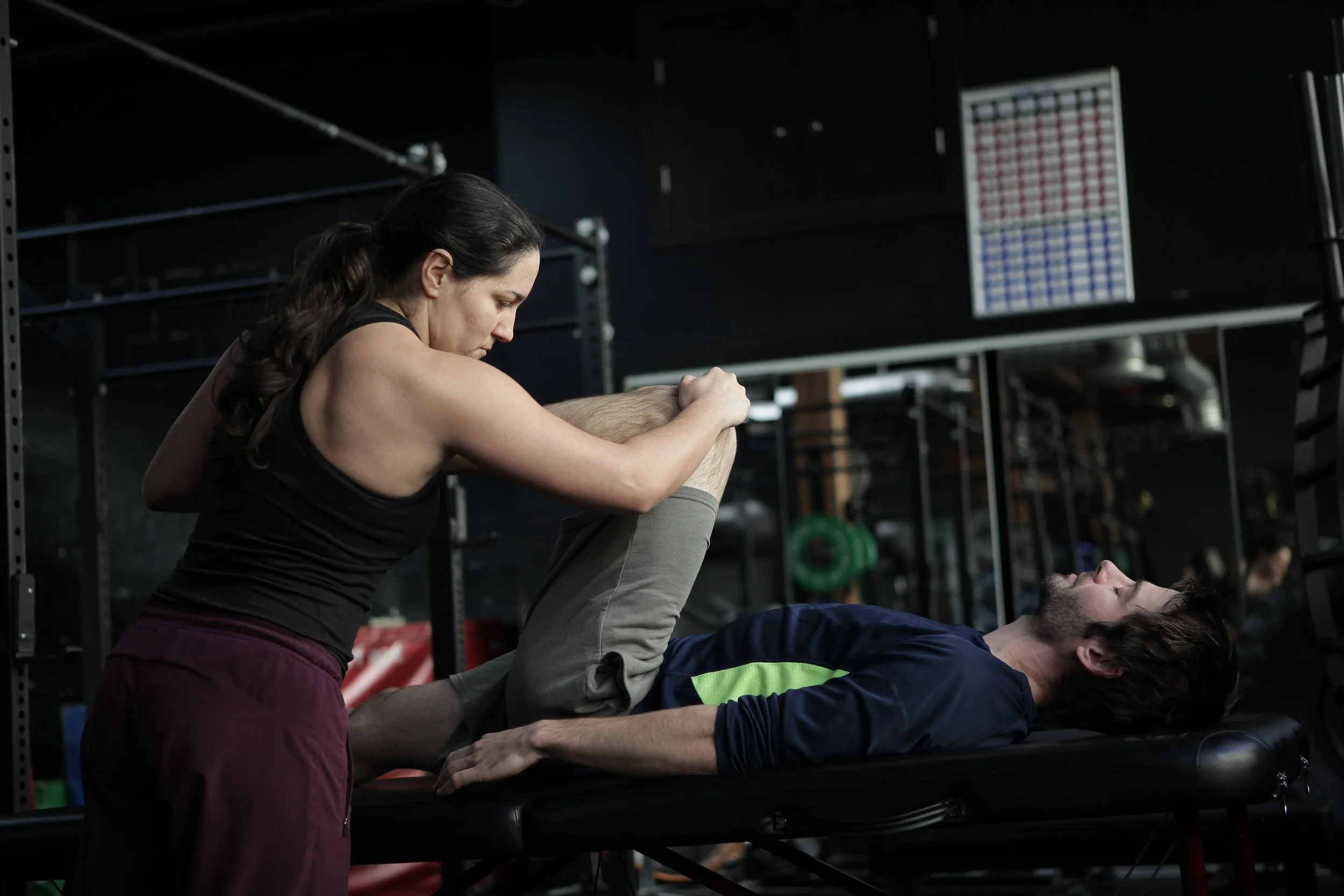
Table assessment being performed during an initial assessment at Avos Strength

After the consult, we begin assessing movement.

We typically look at:

  • Posture and gait

  • Basic functional movements (like squats, toe touches, and rotation)

  • Joint mobility and range of motion on the table

This gives us an idea of how you move in space, where you may feel limited, and what patterns we should be aware of when designing your program. For remote assessments, this part is adapted as best we can based on your space and setup.

This Is Not the Avos Performance Battery

Our initial assessment is different from the Avos Performance Battery, which is a full 90 minute performance testing session that includes a written report. This assessment is about gathering foundational information, not performance metrics. It’s the first building block in your training process, not a test.

What Happens With the Remaining Time?

Depending on how the session flows, we may use the last 10 to 20 minutes to go through some light drills, address pain points, or suggest a few exercises to get you started.

Sometimes we’ll do a bit of strength or movement testing, just enough to give us some useful data without overwhelming you on day one.

Why We Do It This Way

Your initial assessment helps us:

  • Build rapport and trust

  • Understand how you move

  • Identify restrictions or red flags

  • Gather everything we need to design a personalized program

Without this step, we’d be guessing. And that’s not how we operate. Your coach takes the time before, during, and after this session to make sure we’re starting from the right place.

How You Should Feel After

You should walk away feeling heard. You should feel supported. Ideally, you feel excited, not nervous, to start training and build something that’s going to serve you long term.

Training is a skill. It’s a habit. It’s a way of taking care of your body so you can keep doing the things you love, whether that’s playing sports, being active with your family, or just moving better every day.

Common Misconceptions We Hear

“I feel like I’m being judged.”
You’re not. There are no wrong answers in this process. If your hips move a certain way, or your shoulder is limited, that’s all information we use to help you.

“I don’t think I’m fit enough to be assessed yet.”
That’s exactly why we do assessments. You don’t need to be fit. This is about meeting you where you are and giving us a starting point to work from.

“What if I fail?”
You can’t fail. This isn’t a test. It’s a snapshot of where you’re at today.

A Structured, Individualized Approach

Everything we collect goes into your client file, not a generic template. Your program is built from the ground up based on your movement, your goals, your limitations, and your training setup.

Every Avos coach follows this system. Our junior coaches go through a structured mentorship before ever leading assessments on their own, and we continue to support them with feedback and review to maintain high standards.

There are no shortcuts. And that’s the point.


The first session isn't about being perfect. It's about getting started the right way; with a coach who sees you, listens to you, and builds something with you.

If you're ready to take the next step, explore our training options to find the approach that best fits your goals.

Understanding Your Body: The Role of a Kinesiologist in Personal Fitness

Embarking on a fitness journey is a commendable decision that can positively impact various aspects of your life. Whether you're aiming to shed a few pounds, build muscle, or enhance overall well-being, understanding your body is a crucial first step. In this pursuit, a key ally can be found in the expertise of a kinesiologist. In this blog post, we will delve into the pivotal role a kinesiologist plays in personal fitness, shedding light on the science behind movement and the benefits of seeking professional guidance.

Understanding Kinesiology:

Kinesiology is the study of human movement, encompassing anatomy, physiology, biomechanics, and neuroscience. A kinesiologist is a specialist in this field, possessing a deep understanding of how the body moves and functions. Their knowledge extends beyond mere exercise routines, focusing on the science behind movement patterns, muscle function, and the intricate interplay between various physiological systems.

Assessment and Individualized Programs:

One of the primary roles of a kinesiologist is to conduct a comprehensive assessment of an individual's physical condition. This may involve evaluating posture, flexibility, strength, and identifying any imbalances or limitations. Through these assessments, a kinesiologist gains valuable insights into a person's unique physiological profile, allowing them to create personalized fitness programs tailored to specific needs and goals.

Avos Strength Comprehensive Assessment guides program design specific to you

Preventing and Rehabilitating Injuries:

Understanding the body's mechanics enables kinesiologists to identify potential areas of vulnerability and design exercise regimens that minimize the risk of injuries. Moreover, for individuals recovering from injuries, a kinesiologist plays a crucial role in rehabilitation by implementing targeted exercises to restore strength, flexibility, and functionality. This personalized approach aids in a faster and more effective recovery, reducing the likelihood of recurring injuries.

Enhancing Performance:

Whether you're an athlete seeking to improve performance or an individual aiming for optimal fitness, a kinesiologist can be a game-changer. By analyzing movement patterns and biomechanics, they can fine-tune training programs to maximize efficiency and boost overall performance. This not only helps in achieving fitness goals but also enhances the enjoyment and sustainability of the exercise routine.

Educating and Empowering Clients:

In addition to designing exercise programs, kinesiologists play a vital role in educating clients about the importance of proper movement and the impact of physical activity on overall health. Armed with this knowledge, individuals are empowered to make informed choices about their fitness journey, fostering a long-term commitment to a healthy lifestyle.

In the realm of personal fitness, the guidance of a kinesiologist can be a transformative force. Their expertise in understanding the intricacies of the human body goes beyond traditional fitness training, providing a holistic approach to health and well-being. By working with a kinesiologist, individuals can unlock their body's full potential, reduce the risk of injuries, and embark on a journey towards sustainable, lifelong fitness. So, if you're looking to truly understand your body and optimize your fitness experience, consider the invaluable partnership with a kinesiologist – the key to unlocking the full potential of your physical well-being. Contact Avos Strength today to book a Free on boarding call to discuss how we can help you reach your goals.

Why Your Mobility and Stretching is Not Working

Unlocking True Mobility: The Power of Relaxation Over Force

In the world of fitness, the pursuit of improved mobility often takes a backseat to the prevailing belief of "harder, faster, stronger." Unfortunately, this mindset can lead individuals to overlook a crucial aspect of mobility training – the difference between forcing the body into a stretch and the transformative power of progressive relaxation. In this blog post, we'll delve into why your mobility training might not be working and explore the misconception that more effort always yields better results.


The Misconception of "More Effort = Better Results":

1. Fight or Flight vs. Rest and Digest:

One of the primary reasons more effort doesn't always translate to better mobility is the impact on the nervous system. More effort tends to activate the sympathetic nervous system, triggering the "fight or flight" response. When our nervous system perceives a threat, it tightens muscles and restricts movement, hindering the very progress we aim to achieve in mobility training.

2. Creating a Safe Environment:

Mobility work involves repositioning drills and stretching exercises to reach new ranges of motion. However, if the body interprets these positions as threatening, progress becomes stunted. For lasting improvement, it's crucial to create an environment where the body feels safe and secure, encouraging the activation of the parasympathetic nervous system – the "rest and digest" state.


The Sympathetic vs. Parasympathetic Nervous System:

1. Sympathetic Nervous System (SNS):

  • Activated during stress or perceived threats.

  • Triggers the "fight or flight" response.

  • Can inhibit mobility gains due to heightened muscle tension and restricted movement.

2. Parasympathetic Nervous System (PNS):

  • Activated during relaxation and rest.

  • Promotes the "rest and digest" response.

  • Facilitates improved mobility by reducing muscle tension and allowing for greater flexibility.

The Role of Controlled Respiration (Breathing):

1. Breath and Parasympathetic Activation:

  • Controlled breathing is a powerful tool to shift the body into the parasympathetic nervous system.

  • If you can't breathe comfortably in a position, you likely don't own it, and your body may interpret it as a stressor.

2. The Importance of Feeling Safe:

  • A relaxed state during mobility drills signals safety to the nervous system, allowing for greater adaptability and long-term improvement.

“I felt great for a few hours after my massage and then it went right back to what it was before”

- says almost everyone

The Missing Link: Training After Mobility Work

While mobility drills and breathing exercises are critical to unlocking new ranges of motion, there's a common mistake many people make – they stop there. Whether it's after a massage, physio, or chiropractic session, too often people experience temporary relief, only to have their body revert back within hours or days. Why? Because the nervous system hasn't been taught what to do with that new range of motion.

In order to retain and solidify the mobility gains you've just achieved, it's essential to follow up with training or neural stimulation. Your body needs to experience controlled movement in this new range so that it can "remember" and integrate it into your movement patterns.

Why Training Is Key:

When you mobilize, you're creating new possibilities for movement. But without reinforcing it through strength training or neuromuscular engagement, your nervous system doesn't fully integrate these gains. This often leads the body to revert to its previous, more limited movement patterns. By training after mobility work, you’re helping your body understand and use this new range of motion effectively, preventing the regression that so many experience.

Think of it this way: Mobility gives you the access to more range, and training teaches your body how to control and own that new range. To retain and sustain long-term mobility, it's crucial to follow the process of mobilize, then train.

Recap: The One - Two Punch

The key takeaway from the misconception of "more effort, better results" in mobility training is the importance of relaxation over force. However, once you've created a safe and relaxed environment for mobility, the next step is to train or engage in some form of neural stimulus to lock in that newfound range. By understanding the role of the nervous system and the value of progressive relaxation followed by structured movement, you unlock not just short-term gains but sustainable, long-term flexibility and functional movement.

Embrace the power of relaxation, and remember – mobilize, then train for lasting results.

For Free mobility videos click here or to book in a Free Onboarding Call click here.

Does your Knee Cave Inward When you Squat or Lunge?

How many times have you heard someone say drive your knees out when you squat?

- I know I have said it in the past!

What I used to think, was that you could use a band during a split squat to distract the hip, which in essence forced you to drive the knees out. Now while this is not inherently wrong, it may not always be the best solution depending on the individual. Yes, this band will allow you to recruit the glutes more, as you drive the knee outward putting the hip into external rotation,  BUT, this also prevents the natural movement at the hip in certain ranges of motion.

Screen Shot 2019-07-11 at 12.40.24 PM.png

Using a band to drive more external rotation at the hip

Most sticking points occur at about 90° of hip flexion in a squat. At 90° of hip flexion if we look at a movement limb arc model, the hips requires internal rotation of the femur (or the thighbone). At 60 to 110° of hip flexion, the muscles at the back of your hip that do external rotation actually gain more leverage in internal rotation (i.e. they will lengthen).  In order to get into 90° of hip flexion you need space in order to internally rotate the femur. Therefore, by driving the knees out we are actually reducing the amount of space at the back of the hip because we are creating external rotation (driving the knees out and shortening the muscles that should be lengthened at 90° of hip flexion).  This is why it may not be the most effective cue for some people. 

An exercise that I like to use to help prevent the knee from coming in, is a box step down variation with a band around the knee pulling the knee outward (which forces you to resist that motion by driving the knee inward slightly).

Note: always start with body weight and a lower box before you progress to using load with a higher box.

This is a more ideal way to work on knee control, because based on the limb arc model from 60 to 110deg of hip flexion, it requires internal rotation. Here we are forcing the knee to work by internally rotating. You will get even more glute recruitment in addition to adductors (the inner thighs) because these muscle co-contract or work together when you are in single leg stance.

Contact me today for a custom program to help you move better and get stronger to prevent injuries.