Written by Evelyn Calado, MKin, CSCS, RKin
If you've trained at Avos Strength for any length of time, you've probably heard us talk about "the stack."
Whether we're coaching a squat, a deadlift, a breathing drill, a carry, or simply standing posture, the concept comes up repeatedly.
That's because the stack is one of the foundational principles that influences how we breathe, move, stabilize, and produce force.
While it may seem like a small detail, it often has a significant impact on movement quality and performance.
What Is the Stack?
At its simplest, the stack refers to the relationship between the rib cage and the pelvis.
One way to visualize this is to think of both the rib cage and pelvis as buckets of water. When the buckets are stacked on top of one another and remain relatively level, the body is generally in a better position to manage pressure, breathe efficiently, and move well.
When either bucket tips excessively forward or backward, the relationship between the rib cage and pelvis changes. The body may then rely on compensatory strategies to create stability, manage pressure, or access movement.
While no one maintains a perfectly stacked position all the time, this analogy provides a useful framework for understanding why rib cage and pelvic position matter.
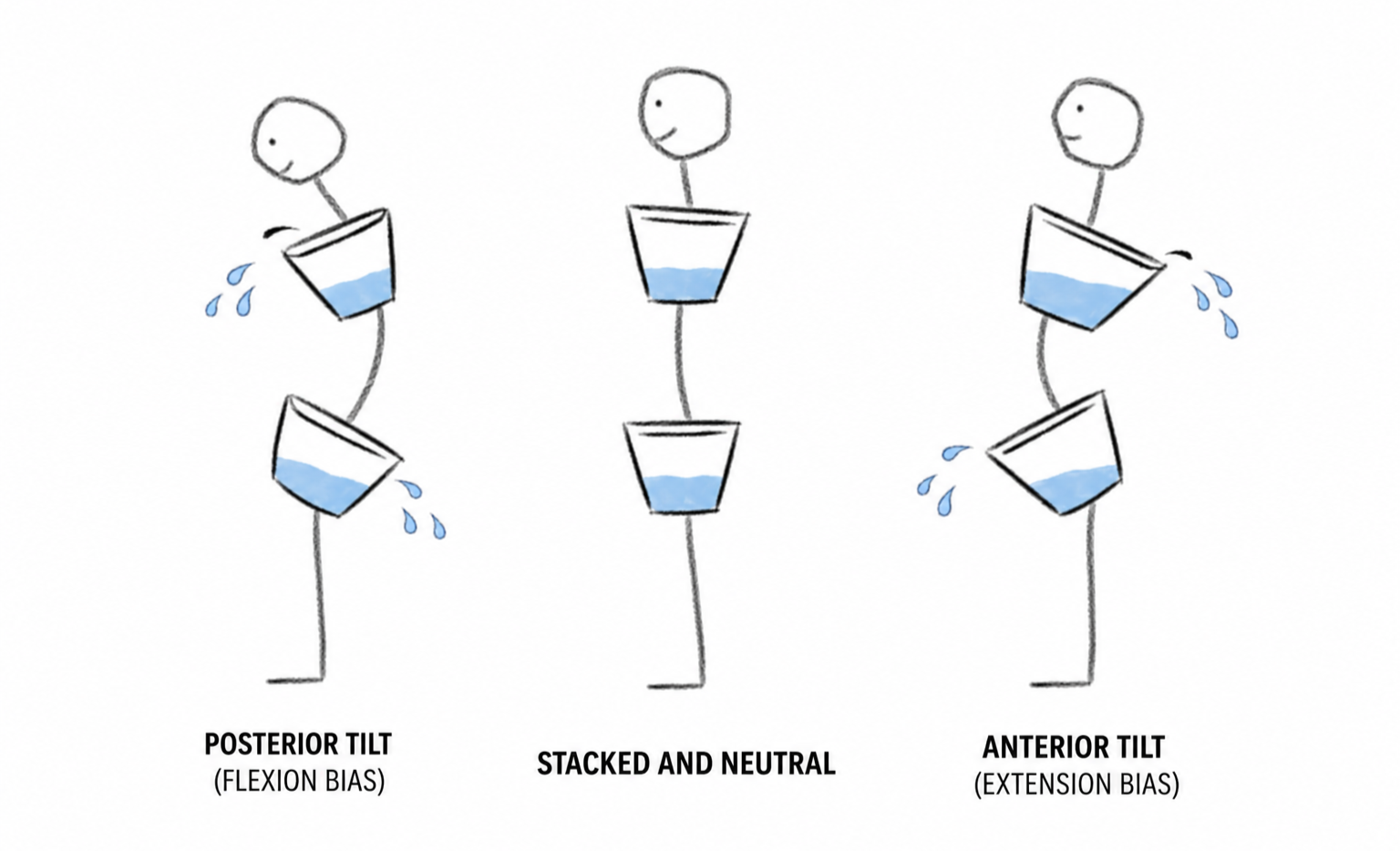
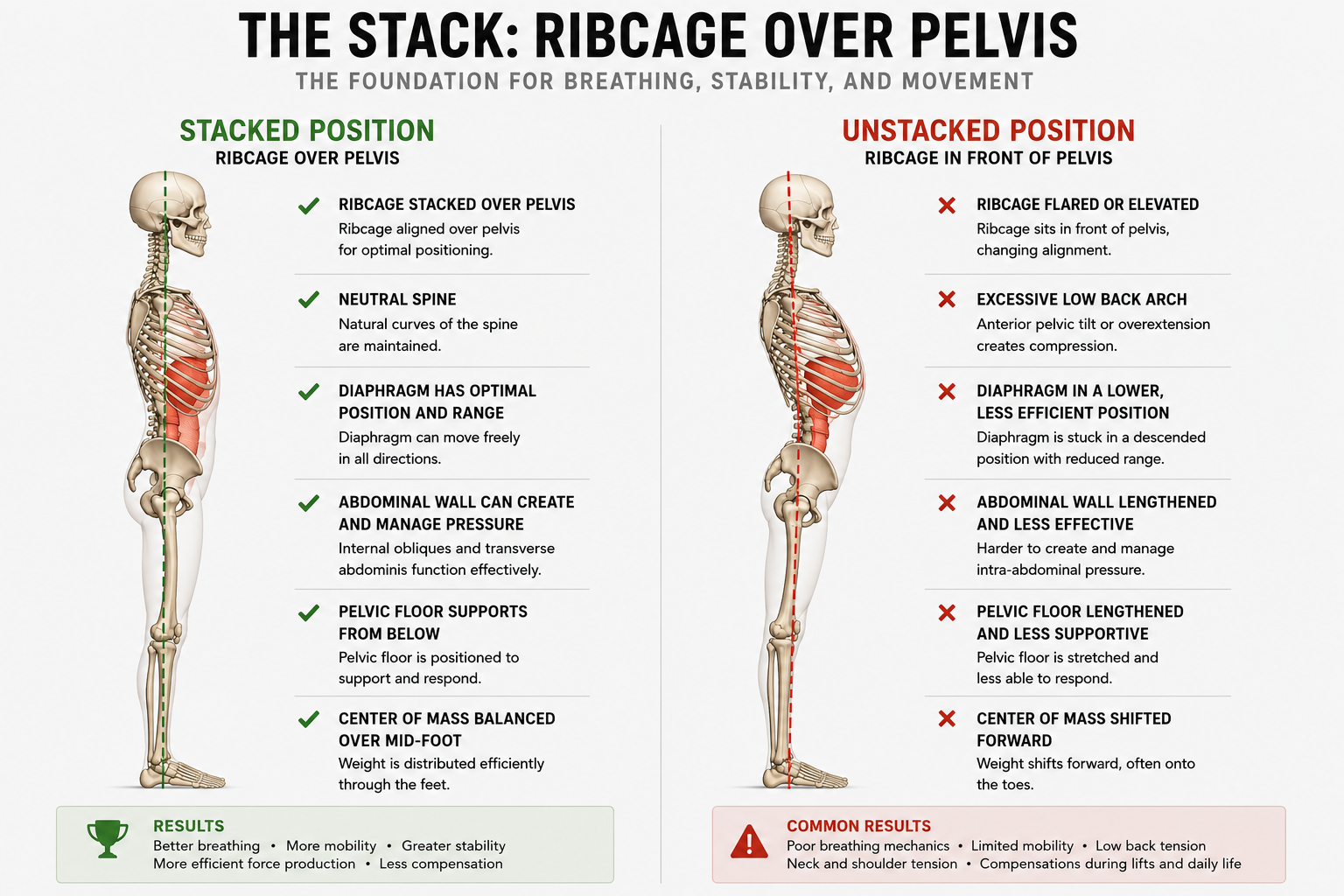
When we talk about being stacked, we're generally referring to the rib cage being positioned over the pelvis.
This doesn't mean flattening the spine, tucking the pelvis excessively, or walking around with your ribs permanently pulled down.
A stacked position still maintains the natural curves of the spine. Instead, it creates an environment where the body can effectively manage pressure, breathe efficiently, and move through available ranges of motion.
From a biomechanical perspective, stacking helps align the thoracic diaphragm and the pelvic floor. These structures form the top and bottom of a pressure system that works together with the abdominal wall to create stability throughout the trunk.
When the rib cage and pelvis are positioned well relative to one another, the body has a stronger foundation from which movement can occur.
Why We Coach the Stack
Many people think of strength, mobility, and stability as separate qualities.
In reality, they are deeply connected.
One of the primary reasons we coach the stack is because it influences the body's ability to manage pressure.
The diaphragm sits at the top of the abdominal cavity. The pelvic floor sits at the bottom. The internal obliques, transverse abdominis, and other abdominal muscles form the walls of this cylinder.
Together, these structures help regulate intra-abdominal pressure.
This pressure system plays a critical role in spinal stability, force transfer, breathing mechanics, and movement efficiency.
When pressure is managed effectively, the body is often able to access movement options more easily and distribute forces more efficiently.
A useful way to think about this is to imagine an empty aluminum pop can. Despite being made of very thin metal, an undamaged can can support a surprising amount of weight when force is distributed evenly through the structure. The moment the side of the can is dented, however, its ability to manage force drops dramatically.
While the human body is far more complex than a pop can, the analogy illustrates an important principle. When the diaphragm, abdominal wall, pelvic floor, rib cage, and pelvis work together to manage pressure, the trunk becomes remarkably efficient at transferring and resisting force.
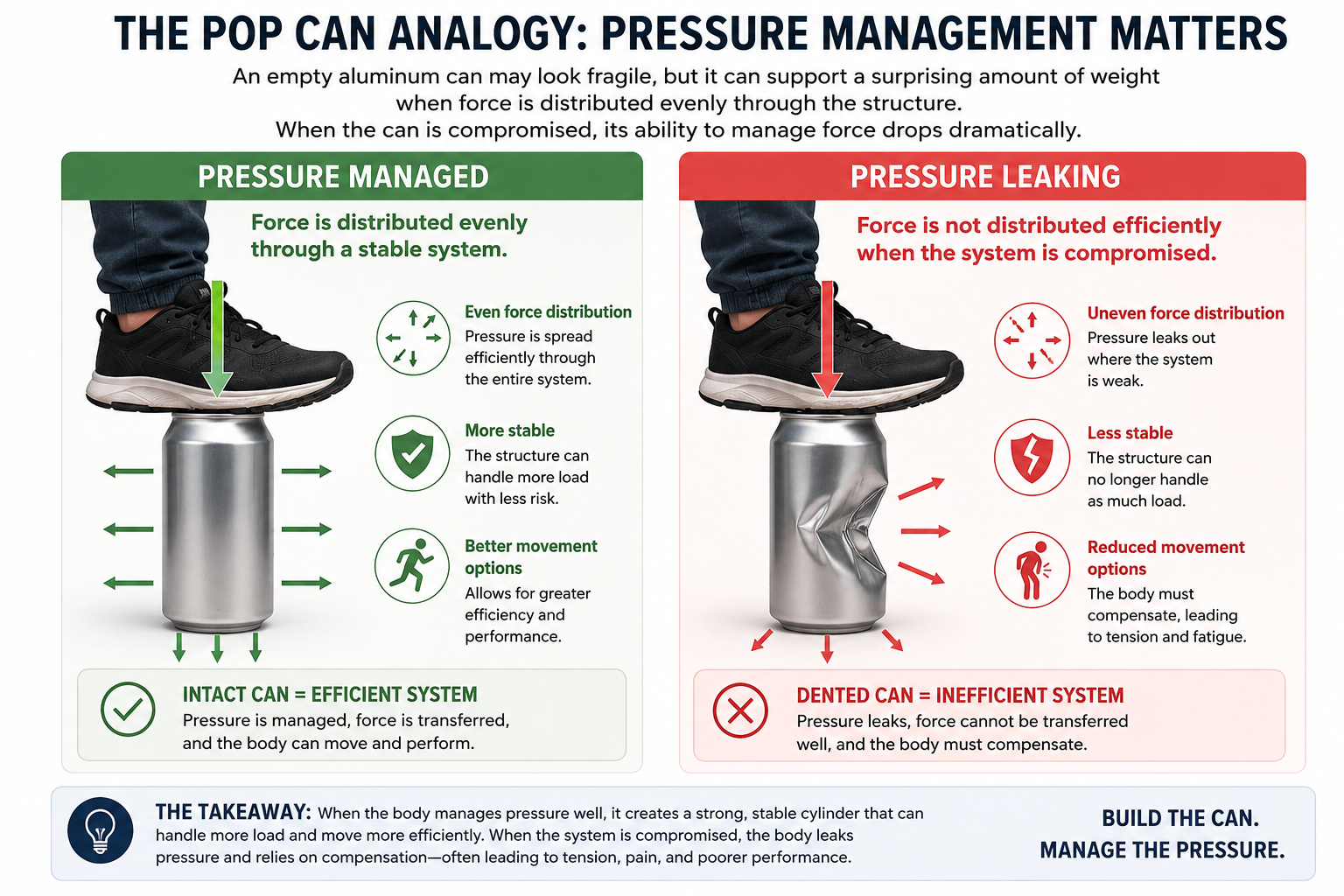
When pressure management is compromised, the body may begin relying on compensatory strategies to create stability and movement.
The stack is not the solution to every problem, but it often provides the foundation that allows other solutions to work.
How the Stack Affects Breathing
Breathing is much more than simply getting air into the lungs.
Effective breathing requires coordination between the diaphragm, rib cage, abdominal wall, and pelvic floor. Together, these structures help create and manage pressure throughout the trunk, providing a foundation for both movement and stability.
When the rib cage and pelvis are positioned well relative to one another, the diaphragm is able to function more effectively. One reason for this is a concept known as the Zone of Apposition, which refers to the area where the diaphragm sits against the inner surface of the lower rib cage.
While the details are beyond the scope of this article, the important takeaway is that the position of the rib cage influences the position and function of the diaphragm.
When the rib cage becomes excessively elevated or flared, the diaphragm may lose some of its mechanical advantage. As a result, the body often begins relying more heavily on accessory muscles of respiration, including muscles of the neck, upper chest, and lower back.
This is one reason why individuals who struggle with breathing mechanics frequently report chronic tension through the neck, shoulders, or low back.
A complete exhalation is often one of the simplest ways to improve this relationship. Exhaling fully helps bring the rib cage down and in, allowing the diaphragm to return to a more advantageous position and creating a better starting point for the next inhale.
When the stack is present, we should see expansion occur throughout the rib cage and abdominal canister rather than exclusively through the chest, shoulders, neck, or belly.
This includes expansion through the front, sides, and back of the rib cage, as well as coordinated movement of the diaphragm and pelvic floor. This is often referred to as 360-degree expansion.
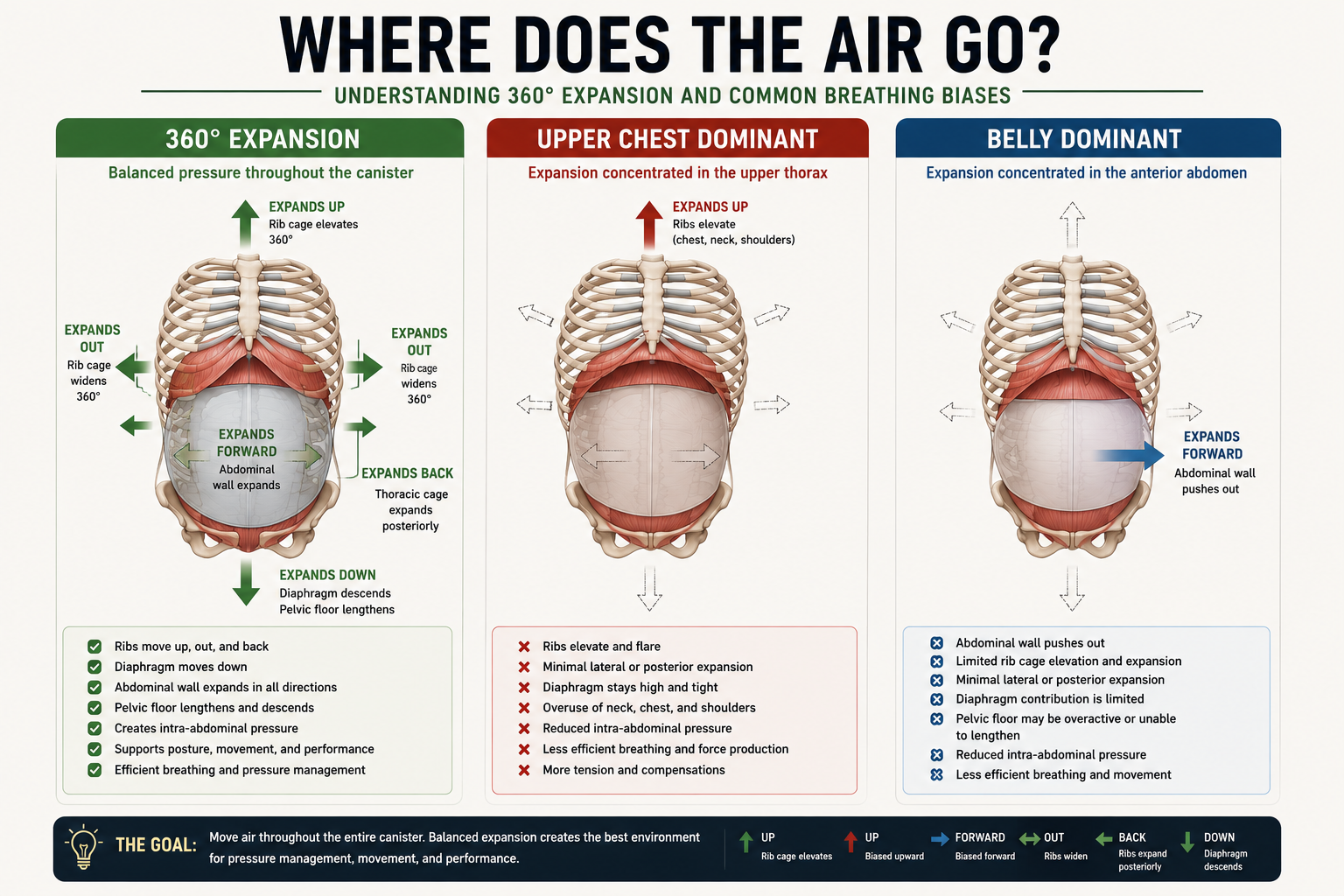
The rib cage itself is designed to move in multiple directions during respiration. As we inhale, the ribs expand and rotate to accommodate incoming air. As we exhale, they return toward a more neutral position. These movements help distribute pressure throughout the system and allow breathing to support movement rather than interfere with it.
When the stack is lost, these expansion patterns can become biased toward a particular region. Some individuals become upper-chest dominant, relying heavily on the neck and shoulders to breathe. Others primarily expand through the front of the abdomen while gaining little expansion through the sides and back of the rib cage.
Our goal is not simply to breathe into the chest or the belly. Our goal is to create balanced expansion throughout the entire canister, allowing the body to efficiently manage pressure, move well, and perform at its best.
How the Stack Affects Mobility
One of the most common misconceptions in fitness is that mobility limitations are always the result of tight muscles.
While tissue restrictions can certainly exist, many mobility limitations are influenced by joint positioning and pressure management.
The body is often reluctant to access movement that it cannot control.
When the rib cage and pelvis are poorly positioned relative to one another, the body may lose access to certain movement options.
This can influence hip internal rotation, thoracic rotation, shoulder motion, and other ranges of motion throughout the body.
As a result, an individual may feel stiff or restricted despite spending significant amounts of time stretching.
In some cases, restoring a better stack can immediately improve movement quality without any traditional stretching at all.
This doesn't mean stretching is unnecessary. Rather, it highlights the importance of addressing the underlying positional and pressure-management strategies that influence movement.
At Avos Strength, we frequently assess movement both before and after breathing and positional interventions. It is not uncommon to see meaningful changes in mobility once the body is placed in a position that allows it to better manage pressure.
How the Stack Affects Strength and Performance
Strength is ultimately the ability to produce and transfer force.
The stack plays an important role in both.
When the rib cage and pelvis are positioned effectively, the body is often better able to transfer force between the upper and lower extremities.
This can influence performance in squatting, deadlifting, pressing, carrying, sprinting, jumping, and change-of-direction activities.
The stack also influences the body's center of mass.
An individual's ability to shift, rotate, accelerate, and decelerate depends in part on where their mass is positioned and how effectively they can manage it.
When the body relies heavily on compensatory strategies, force production may become less efficient and movement options may become more limited.
This is one reason why we frequently revisit the stack during both rehabilitation and performance-focused training.
How We Help Clients Find Their Stack
For most clients, learning the stack begins with breathing.
One of the simplest ways to improve the relationship between the rib cage and pelvis is through a full exhalation. By fully exhaling, the ribs are able to move down and in, allowing the diaphragm, abdominal wall, and pelvic floor to work together more effectively.
If you'd like to try this yourself, watch our short video demonstrating how to find a stacked position from standing.
For some individuals, finding this position can be challenging while standing. In these situations, positional drills may be useful. Exercises such as a 90-90 Hip Lift can help reduce the influence of gravity and provide the body with a simpler environment in which to learn how to manage pressure and find a stacked position.
From there, we gradually integrate these concepts into movement.
This may involve developing awareness of rib cage position, pelvic position, foot pressure, breathing mechanics, and how these factors influence movement quality.
The appropriate strategy depends on the individual.
Our goal is not to force every client into the same posture. Rather, we aim to improve their ability to manage pressure, access movement options, and move efficiently.
As clients become more aware of these relationships, they often develop a greater understanding of how breathing, mobility, strength, and movement quality are interconnected.
Final Thoughts
The stack is not a magic position.
Nor is it a position that we aim to maintain at all times.
Movement is dynamic. Athletes constantly move through flexion, extension, rotation, and lateral movement depending on the demands of the task in front of them. The goal is not to remain perfectly stacked at all times or to create a rigid posture. Rather, the stack provides a foundation from which movement can occur. When the body can effectively organize the relationship between the rib cage and pelvis, it is often better able to transition into and out of different positions while maintaining efficient breathing, pressure management, and force production.
The stack simply provides a foundation.
It is a position from which the body can effectively manage pressure, breathe efficiently, and access movement options when needed.
When the rib cage and pelvis work together effectively, the body is often able to breathe better, manage pressure more efficiently, access movement options, and transfer force more effectively.
For that reason, the stack remains one of the most important concepts we teach at Avos Strength.
Whether the goal is improved mobility, greater strength, athletic performance, or simply moving and feeling better, the stack provides a foundation upon which all of those qualities can be built.
If you'd like hands-on coaching to find your own stacked position and build it into your training, our 1-on-1 Training sessions start exactly here.