kinesiology

Why “Evidence-Based Training” Means Nothing Without Real Coaching

Written by Evelyn Calado, MKin, CSCS, RKin

The term “evidence-based training” gets thrown around a lot. But what actually makes a coach evidence-based? Reading studies? Having a kinesiology degree? Posting PubMed screenshots on Instagram?

True evidence-based practice goes far beyond quoting research. It is about combining the best available evidence with real-world experience and applying it to the needs of the person in front of you. Too often, that third piece gets ignored.

Foundations First: Coaching Is a Skill, Not a Certificate

You cannot replace lived experience and movement literacy with citations. A coach should know how to move well, demonstrate patterns clearly, and teach with purpose. That takes time under the bar, time on the floor, and years of refining their craft.

You can have a kinesiology degree and still not know how to coach a hinge or assess a client’s squat depth.

At Avos Strength, every junior coach goes through a structured three-month mentorship. They do not just learn protocols. They shadow real sessions, practice cueing, and refine how they coach. Because knowing the “why” is not enough. You also need to know how to deliver the “how.”

Shadowing Matters: Who You Learn From Shapes How You Coach

There is nothing wrong with being new. But good coaches are forged through time, mentorship, and reps.

I shadowed for years without getting paid. Why? Because that is how you build the craft.

Watching seasoned coaches, asking questions, getting feedback, and coaching real people is where you truly grow.

If you are looking to work with a coach, ask:

  • Who did they learn from?

  • Do they train themselves?

  • Do they continue to shadow and learn?

Education without application is just theory.

Yes, the Research Matters. But Know What It Really Says

Let’s be clear. The research is valuable. But it must be understood in context.

Take hypertrophy. For years, people believed you had to train in the 6 to 12 rep range to build muscle. But newer research shows you can build muscle at a wide variety of rep ranges, as long as effort and volume are managed properly.

That means the “best” rep range is the one that fits the person’s goals, experience, and recovery capacity. That is where coaching comes in.

The Bottom Line: Coaching Comes First

Evidence-based is not a title. It is a practice. And that practice only works when you have coaches who understand movement, know how to teach it, and apply research with intention.

If you are a client, look for a coach who:

  • Moves well and teaches movement clearly

  • Understands the research but does not hide behind it

  • Has put in time shadowing and learning from experienced professionals

  • Tailors training to your needs, not just to a textbook

If you are a coach, do the real work. Don’t just quote studies. Learn to coach.

Want to Train with Coaches Who Walk the Talk?

At Avos Strength, we believe in continuous learning and real-world coaching. Every coach trains hard, studies smart, and stays on the floor. We do not just say we are evidence-based. We prove it in every session.

Click to Start Training with Us

Strengthening Bonds and Bodies: The Power of Corporate Group Training for Team Building

In today's fast-paced corporate world, where deadlines loom large and stress levels soar, fostering a sense of camaraderie and teamwork among employees is crucial for success. As companies strive to enhance productivity and employee satisfaction, innovative approaches to team building are gaining traction. One such approach that has been gaining popularity is corporate group training, where colleagues come together to sweat it out and strengthen not only their bodies but also their bonds.

Large group of employees stretching together during a corporate group training session

Fitness has long been recognized for its ability to improve physical health and well-being. However, its impact extends far beyond the confines of the gym. When incorporated into a corporate setting, group training sessions offer a unique opportunity for employees to connect, collaborate, and communicate outside the usual office environment. Here's how corporate group training contributes to team building:

  1. Shared Goals and Achievements: In a group training session, employees work towards a common goal – whether it's completing a challenging workout, achieving a personal best, or simply pushing through mental barriers. Sharing these experiences creates a sense of unity and fosters a team spirit where everyone celebrates each other's successes.

  2. Breaking Down Hierarchies: In the gym, titles and job descriptions take a back seat to sweat and effort. Group training sessions provide a level playing field where employees of all levels can interact on a more personal level. This helps break down hierarchical barriers, fostering open communication and collaboration across departments and teams.

  3. Building Trust and Support: Group workouts often involve partner exercises or team challenges that require trust and cooperation. When colleagues rely on each other to complete a workout or reach a fitness goal, bonds of trust are strengthened. This trust transcends the gym and carries over into the workplace, where colleagues feel more supported and connected to one another.

  4. Stress Reduction and Improved Morale: Exercise is a proven stress reliever, releasing endorphins that boost mood and energy levels. By incorporating regular group training sessions into the workweek, companies can help employees manage stress more effectively, leading to improved morale and a more positive work environment.

  5. Healthy Competition: While teamwork is essential, a bit of friendly competition can also be beneficial. Group training sessions often incorporate elements of friendly competition, such as team challenges or friendly races. This healthy competition encourages employees to push themselves further while also fostering a sense of camaraderie and sportsmanship.

  6. Promoting Work-Life Balance: Encouraging employees to prioritize their health and fitness sends a powerful message about the company's commitment to employee well-being. By providing opportunities for group training during work hours or offering fitness incentives, companies demonstrate their support for maintaining a healthy work-life balance.

  7. Enhanced Communication Skills: Effective communication is essential for successful teamwork. Group training sessions provide a non-traditional setting for colleagues to interact, communicate, and problem-solve together. Whether it's coordinating movements during a group exercise or offering encouragement to a struggling teammate, employees have the opportunity to hone their communication skills in a supportive environment.

Group of employees stretching together during corporate team training

In conclusion, corporate group training offers far more than just physical benefits – it's a powerful tool for fostering teamwork, building relationships, and creating a positive work culture. By investing in the health and well-being of their employees through group fitness initiatives, companies can reap the rewards of a stronger, more cohesive team ready to tackle any challenge that comes their way. So, let's lace up our sneakers, break a sweat, and build stronger teams, one workout at a time.

If you're interested in bringing group training to your workplace, learn more about our corporate and team training options here.

Understanding Your Body: The Role of a Kinesiologist in Personal Fitness

Embarking on a fitness journey is a commendable decision that can positively impact various aspects of your life. Whether you're aiming to shed a few pounds, build muscle, or enhance overall well-being, understanding your body is a crucial first step. In this pursuit, a key ally can be found in the expertise of a kinesiologist. In this blog post, we will delve into the pivotal role a kinesiologist plays in personal fitness, shedding light on the science behind movement and the benefits of seeking professional guidance.

Understanding Kinesiology:

Kinesiology is the study of human movement, encompassing anatomy, physiology, biomechanics, and neuroscience. A kinesiologist is a specialist in this field, possessing a deep understanding of how the body moves and functions. Their knowledge extends beyond mere exercise routines, focusing on the science behind movement patterns, muscle function, and the intricate interplay between various physiological systems.

Assessment and Individualized Programs:

One of the primary roles of a kinesiologist is to conduct a comprehensive assessment of an individual's physical condition. This may involve evaluating posture, flexibility, strength, and identifying any imbalances or limitations. Through these assessments, a kinesiologist gains valuable insights into a person's unique physiological profile, allowing them to create personalized fitness programs tailored to specific needs and goals.

Avos Strength Comprehensive Assessment guides program design specific to you

Preventing and Rehabilitating Injuries:

Understanding the body's mechanics enables kinesiologists to identify potential areas of vulnerability and design exercise regimens that minimize the risk of injuries. Moreover, for individuals recovering from injuries, a kinesiologist plays a crucial role in rehabilitation by implementing targeted exercises to restore strength, flexibility, and functionality. This personalized approach aids in a faster and more effective recovery, reducing the likelihood of recurring injuries.

Enhancing Performance:

Whether you're an athlete seeking to improve performance or an individual aiming for optimal fitness, a kinesiologist can be a game-changer. By analyzing movement patterns and biomechanics, they can fine-tune training programs to maximize efficiency and boost overall performance. This not only helps in achieving fitness goals but also enhances the enjoyment and sustainability of the exercise routine.

Educating and Empowering Clients:

In addition to designing exercise programs, kinesiologists play a vital role in educating clients about the importance of proper movement and the impact of physical activity on overall health. Armed with this knowledge, individuals are empowered to make informed choices about their fitness journey, fostering a long-term commitment to a healthy lifestyle.

In the realm of personal fitness, the guidance of a kinesiologist can be a transformative force. Their expertise in understanding the intricacies of the human body goes beyond traditional fitness training, providing a holistic approach to health and well-being. By working with a kinesiologist, individuals can unlock their body's full potential, reduce the risk of injuries, and embark on a journey towards sustainable, lifelong fitness. So, if you're looking to truly understand your body and optimize your fitness experience, consider the invaluable partnership with a kinesiologist – the key to unlocking the full potential of your physical well-being. Contact Avos Strength today to book a Free on boarding call to discuss how we can help you reach your goals.

Unveiling the Difference: Certified Strength and Conditioning Specialists vs. Personal Trainers

Are you seeking to embark on a fitness journey or enhance your athletic performance in Vancouver, BC? If so, you've probably come across two professionals who can help you achieve your goals: Certified Strength and Conditioning Specialists (CSCS) and Personal Trainers. While both play essential roles in fitness and wellness, there are significant differences between the two that can greatly impact your success and safety. In this blog post, we'll explore these distinctions and why choosing a CSCS, especially in a fitness-forward city like Vancouver, can be a game-changer for your fitness journey.

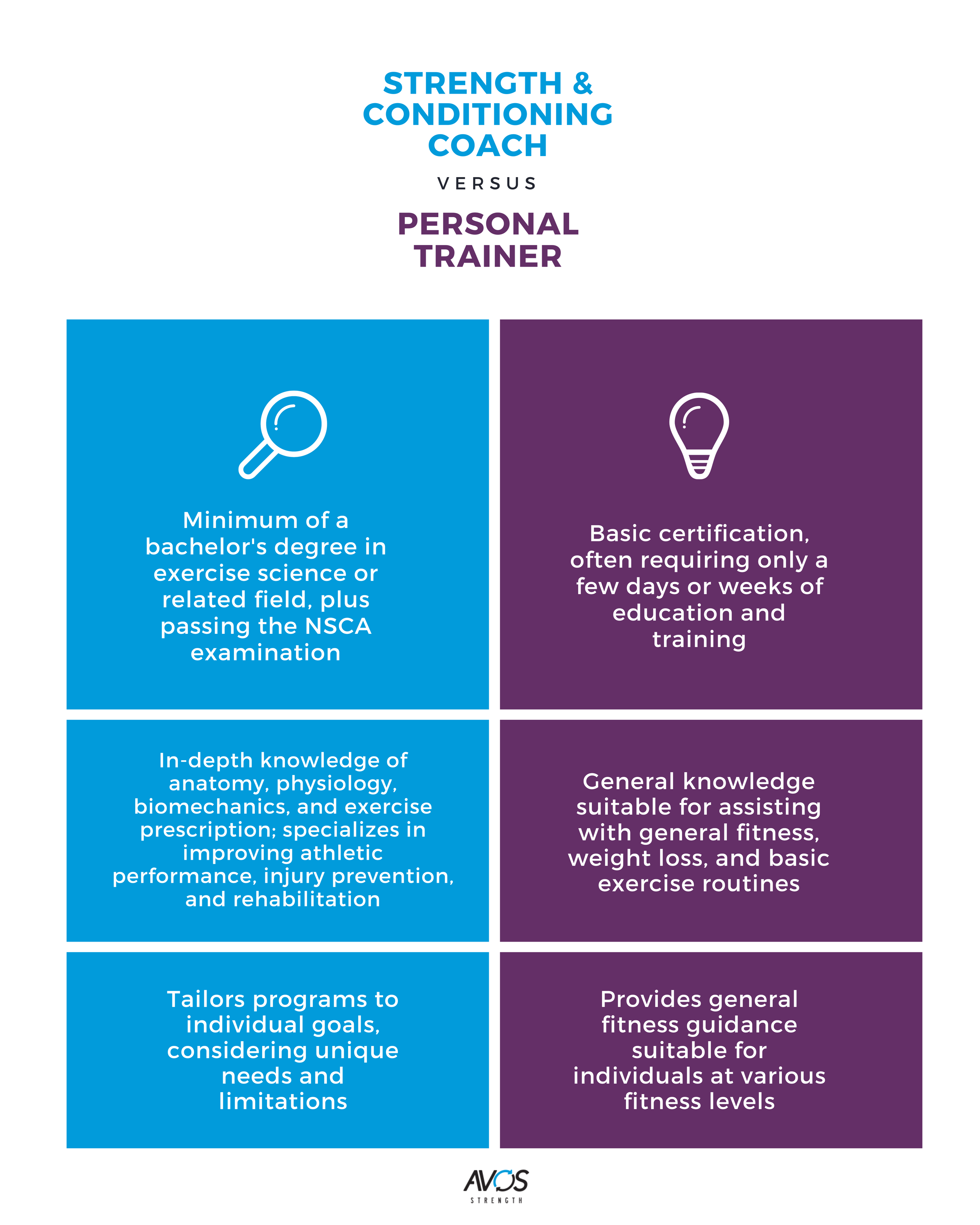
Comparison graphic showing the differences between a CSCS and a personal trainer in Vancouver  Once both of these are done, this post will be genuinely complete, no more open items. Let me know when they're in.


The Role of a Personal Trainer:

Personal trainers are undoubtedly valuable in helping individuals pursue their fitness aspirations. Many personal trainers are passionate about health and fitness, and they often hold basic certifications, typically requiring only a few days or weeks of education and practical training. They can assist clients with general fitness, weight loss, and basic exercise routines, making them suitable for people at various fitness levels.


The Expertise of a Certified Strength and Conditioning Specialist (CSCS):

On the other hand, Certified Strength and Conditioning Specialists are a different breed. CSCS professionals, like Evelyn, have undergone rigorous formal education, typically earning at least a bachelor's degree in exercise science, kinesiology, or a related field. Moreover, they must pass a challenging examination by the National Strength and Conditioning Association (NSCA). This in-depth preparation equips CSCS professionals with a deep understanding of anatomy, physiology, biomechanics, and exercise prescription. They specialize in improving athletic performance, injury prevention, and rehabilitation.


Why Choose a CSCS in Vancouver, BC:

1. Advanced Expertise: Vancouver is known for its active lifestyle, from hiking the Grouse Grind to enjoying the local beaches. CSCS professionals understand the demands of various sports and outdoor activities and can tailor programs to maximize your performance and minimize your risk of injury.

2. Injury Prevention: Vancouverites love to stay active, but with that comes an increased risk of injuries. CSCS professionals are well-versed in injury prevention strategies, ensuring that you can enjoy your favorite activities without unnecessary setbacks.

3. Personalized Training: CSCS professionals, with their extensive knowledge, can design highly personalized training programs that address your unique goals and limitations, helping you achieve results efficiently and safely.

4. Accountability and Long-term Success: Vancouver's fitness scene is competitive, but with a CSCS, you'll have a dedicated professional who's committed to your long-term success, ensuring that you stay motivated and continue progressing.


Conclusion:

While personal trainers have their place in the fitness industry, the depth of knowledge and expertise provided by a Certified Strength and Conditioning Specialist sets them apart, especially in a fitness-conscious city like Vancouver, BC. As a registered kinesiologist with over a decade of experience, Evelyn understands the importance of comprehensive education and specialized training. By choosing a CSCS for your fitness journey in Vancouver, you're investing in your health, performance, and overall well-being. Don't settle for one-day certifications when you can have the guidance and support of a highly qualified CSCS to help you achieve your fitness goals and enjoy a thriving life in this beautiful city.