Mobility

How Do I Get Bigger Arms and Improve Shoulder Mobility?

 Let’s be realistic here, everyone likes training their arms. But what if you could not only increase strength but also shoulder mobility?


When considering the training of these two muscle groups, it's important to understand their respective functions:

  • Biceps are responsible for flexing the arm, contributing to joint actions associated with flexion like external rotation and abduction.

  • Triceps, on the other hand, extend the arm, facilitating joint actions linked to extension such as internal rotation and adduction.


With this knowledge, we can target external rotation and flexion of the shoulder complex by incorporating biceps curls and variations into our routine. Similarly, triceps exercises can help improve internal rotation and arm extension.

Posterior Expansion for External Rotation

It's worth noting that shoulder external rotation and flexion are influenced by the amount of expansion and the ability to open up the back of you ribcage. Limited range of motion may result from compression or tightness in this area. To address this issue, it's essential to position the scapula (shoulder blades) in a way that allows for movement away from the spine, creating space for decompression. Abduction of the scapula facilitates this movement, as it involves shifting the scapula away from the body's midline.
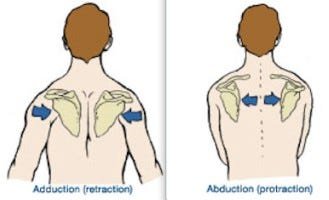
Note: during ADDUCTION the scapula move toward the midline of the body which compresses this area (those muscles are concentrically oriented). During ABDUCTION the scapula move away from the mid line which allows provides space and therefore expansion in this area.

BICEPS

Curl variations are particularly effective in promoting scapular abduction, as they encourage natural movement of the scapula during elbow flexion, thereby opening and decompressing the upper back.

For instance, performing curls in a deep squat position with cables can enhance this effect. The deep squat necessitates back decompression, which can be further facilitated by using a wedge.  This drill can help open up space to restore shoulder external rotation and flexion.


Another example involves preacher curls with a focus on active rotation:

During the preacher curl, introducing a slight turn to the working side naturally creates space between the scapula and spine in the upper back area (by closing off the front of the chest). This action generates a subtle stretch that can be felt between the spine and scapula, contributing to the decompression of that space and facilitating more opening of the ribcage as you inhale and execute the curl.

Anterior Expansion for Internal Rotation

Shoulder internal rotation and extension are influenced by the amount of expansion and the ability to open up the front of your ribcage. If you are compressed in this area, you will be limited in shoulder internal rotation and extension. There are multiple ways that we can promote expansion to these areas. The first one being gravity. If you imagine a bottle of water that is horizontal, the water will all pool on the bottom of the bottle. Our bodies are analagous to that water, if we put ourselves in a bent over or quadruped position, and our breathe is what can help drive expansion of our ribcage in these positions. Another way is to influence joint positions. Pronation of the forearm leads to Internal rotation of the humerus and External rotation and Adduction of the scapula which helps to promote anterior expansion of the ribcage.

TRICEPS

In this position we are able to use our breath to promote expansion at the front of our chest which can help improve shoulder internal rotation. The bent over posted position also further promotes expansion at the front of our chest.


In this drill the pronated hand helps drive internal rotation at the forearm, scapula adduction and external rotation (concentrically closing off the back) to open up the front of the chest.


I will usually perform 3 sets of 10-12 controlled reps. Breathe in through the nose (this will allow optimal expansion of the ribcage) and exhale with an open mouth on each rep.

So next time you add some arm accessory work to your program, think about how you can best promote some mobility gains in addition to getting an arm pump.

Why Your Mobility and Stretching is Not Working

Unlocking True Mobility: The Power of Relaxation Over Force

In the world of fitness, the pursuit of improved mobility often takes a backseat to the prevailing belief of "harder, faster, stronger." Unfortunately, this mindset can lead individuals to overlook a crucial aspect of mobility training – the difference between forcing the body into a stretch and the transformative power of progressive relaxation. In this blog post, we'll delve into why your mobility training might not be working and explore the misconception that more effort always yields better results.


The Misconception of "More Effort = Better Results":

1. Fight or Flight vs. Rest and Digest:

One of the primary reasons more effort doesn't always translate to better mobility is the impact on the nervous system. More effort tends to activate the sympathetic nervous system, triggering the "fight or flight" response. When our nervous system perceives a threat, it tightens muscles and restricts movement, hindering the very progress we aim to achieve in mobility training.

2. Creating a Safe Environment:

Mobility work involves repositioning drills and stretching exercises to reach new ranges of motion. However, if the body interprets these positions as threatening, progress becomes stunted. For lasting improvement, it's crucial to create an environment where the body feels safe and secure, encouraging the activation of the parasympathetic nervous system – the "rest and digest" state.


The Sympathetic vs. Parasympathetic Nervous System:

1. Sympathetic Nervous System (SNS):

  • Activated during stress or perceived threats.

  • Triggers the "fight or flight" response.

  • Can inhibit mobility gains due to heightened muscle tension and restricted movement.

2. Parasympathetic Nervous System (PNS):

  • Activated during relaxation and rest.

  • Promotes the "rest and digest" response.

  • Facilitates improved mobility by reducing muscle tension and allowing for greater flexibility.

The Role of Controlled Respiration (Breathing):

1. Breath and Parasympathetic Activation:

  • Controlled breathing is a powerful tool to shift the body into the parasympathetic nervous system.

  • If you can't breathe comfortably in a position, you likely don't own it, and your body may interpret it as a stressor.

2. The Importance of Feeling Safe:

  • A relaxed state during mobility drills signals safety to the nervous system, allowing for greater adaptability and long-term improvement.

“I felt great for a few hours after my massage and then it went right back to what it was before”

- says almost everyone

The Missing Link: Training After Mobility Work

While mobility drills and breathing exercises are critical to unlocking new ranges of motion, there's a common mistake many people make – they stop there. Whether it's after a massage, physio, or chiropractic session, too often people experience temporary relief, only to have their body revert back within hours or days. Why? Because the nervous system hasn't been taught what to do with that new range of motion.

In order to retain and solidify the mobility gains you've just achieved, it's essential to follow up with training or neural stimulation. Your body needs to experience controlled movement in this new range so that it can "remember" and integrate it into your movement patterns.

Why Training Is Key:

When you mobilize, you're creating new possibilities for movement. But without reinforcing it through strength training or neuromuscular engagement, your nervous system doesn't fully integrate these gains. This often leads the body to revert to its previous, more limited movement patterns. By training after mobility work, you’re helping your body understand and use this new range of motion effectively, preventing the regression that so many experience.

Think of it this way: Mobility gives you the access to more range, and training teaches your body how to control and own that new range. To retain and sustain long-term mobility, it's crucial to follow the process of mobilize, then train.

Recap: The One - Two Punch

The key takeaway from the misconception of "more effort, better results" in mobility training is the importance of relaxation over force. However, once you've created a safe and relaxed environment for mobility, the next step is to train or engage in some form of neural stimulus to lock in that newfound range. By understanding the role of the nervous system and the value of progressive relaxation followed by structured movement, you unlock not just short-term gains but sustainable, long-term flexibility and functional movement.

Embrace the power of relaxation, and remember – mobilize, then train for lasting results.

For Free mobility videos click here or to book in a Free Onboarding Call click here.