
The barbell back squat is primarily considered a lower-body exercise, but sometimes the limiting factor isn't your legs. It's getting your upper body into a comfortable position underneath the bar.
Wrist soreness or pain during back squats is a common complaint among recreational lifters. The first instinct is often to change the position of the hands: widen the grip, move the thumbs over the bar, adjust the elbows, or try to straighten the wrists.
Sometimes, that's all that's needed.
But what happens when you've adjusted your setup and your wrists still hurt?
The problem may not simply be your wrist position. Your wrists are at the end of a chain involving your hands, elbows, shoulders, shoulder blades and ribcage. If you can't comfortably access the shoulder position required to get underneath the bar, your body still has to find a way to get there.
For some lifters, that means compensating through the wrists.
What Position Does a Back Squat Require?
Although we think of the squat as a lower-body exercise, securing a barbell across your back creates significant demands on the upper body.
Your shoulders have to move into a combination of abduction and external rotation as your arms reach behind you. Your shoulder blades need to organize around your ribcage while your upper back creates a stable shelf for the bar.
Your hands help secure the bar in this position, but they shouldn't be responsible for supporting a significant portion of its weight.
If you can create a secure shelf with your upper back and comfortably reach the bar, some wrist extension isn't necessarily a problem. Plenty of lifters squat comfortably with their wrists slightly extended.
The issue is when the wrist has to extend farther to compensate for a position that isn't available elsewhere.
Instead of only asking:
"How do I keep my wrists straighter?"
A better question may be:
"Why do my wrists need to be in this position in the first place?"
Shoulder External Rotation May Be Part of the Puzzle
Try putting your arms into your normal back squat position without a bar.
Your upper arm has to externally rotate as you reach behind yourself. Exactly how much motion you need depends on your anatomy, grip width, bar placement and whether you squat high bar or low bar.
If you have enough movement available, you can establish your grip while keeping the bar securely supported across your upper back.
If you don't, your body still has to reach the bar somehow.
One option is to widen your grip. This generally reduces the shoulder mobility required, which is why changing grip width is one of the first adjustments worth trying.
But there's a limit to what changing your grip can accomplish.
If the required shoulder position still isn't available, you may compensate elsewhere. Your elbows may flare farther behind you, your ribcage may extend, or your wrists may extend further to maintain your grip on the bar.
That doesn't mean elbow flare or wrist extension is automatically bad.
The position becomes more relevant when it is painful, unstable, or changes significantly as load increases.
This is also why simply cueing someone to straighten their wrists may not solve the problem. If wrist extension is helping you compensate for shoulder motion you can't currently access, removing that compensation doesn't suddenly create more shoulder external rotation.
The Shoulder and Ribcage Don't Work Independently
Shoulder external rotation isn't just about the glenohumeral joint.
The scapula sits on the ribcage, and the orientation and movement of the thorax can influence how the scapula moves and the shoulder motion available above it.
Research has shown that changing thoracic posture can alter scapular kinematics and available shoulder range of motion (Kebaetse et al., 1999). Thoracic position has also been shown to influence scapulothoracic and glenohumeral contributions during shoulder external rotation (Yoshimi et al., 2022).
That doesn't mean your ribcage position is necessarily causing your wrist pain. It does mean that assessing shoulder external rotation without considering the thorax and scapula can miss part of the picture.
What About Posterior Expansion?
For some lifters, we may also look at their ability to expand the posterior ribcage, particularly through the upper and mid-thoracic region around T2–T7.
The scapula needs an appropriate surface on the ribcage to move and orient itself. If someone has limited posterior thoracic expansion, addressing that may give the scapula and shoulder additional movement options.
Research examining restricted thoracic expansion has demonstrated changes in scapular posterior tilt and glenohumeral external rotation during an external-rotation task (Yoshimi et al., 2022). That doesn't establish posterior compression as the cause of wrist pain during squatting, but it gives us a biomechanical rationale for considering thoracic expansion when assessing the position.
One drill we may use is a seated posterior expansion drill.
Rather than thinking of this as a shoulder stretch, the goal is to encourage expansion through the posterior ribcage and give the scapula a different surface to move on.
The important part comes next:
Retest the squat.
If the drill changes your ability to comfortably get underneath the bar, that's useful information. If nothing changes, there's little reason to assume that posterior expansion was the missing piece.
Can You Get Under the Bar While Staying Stacked?
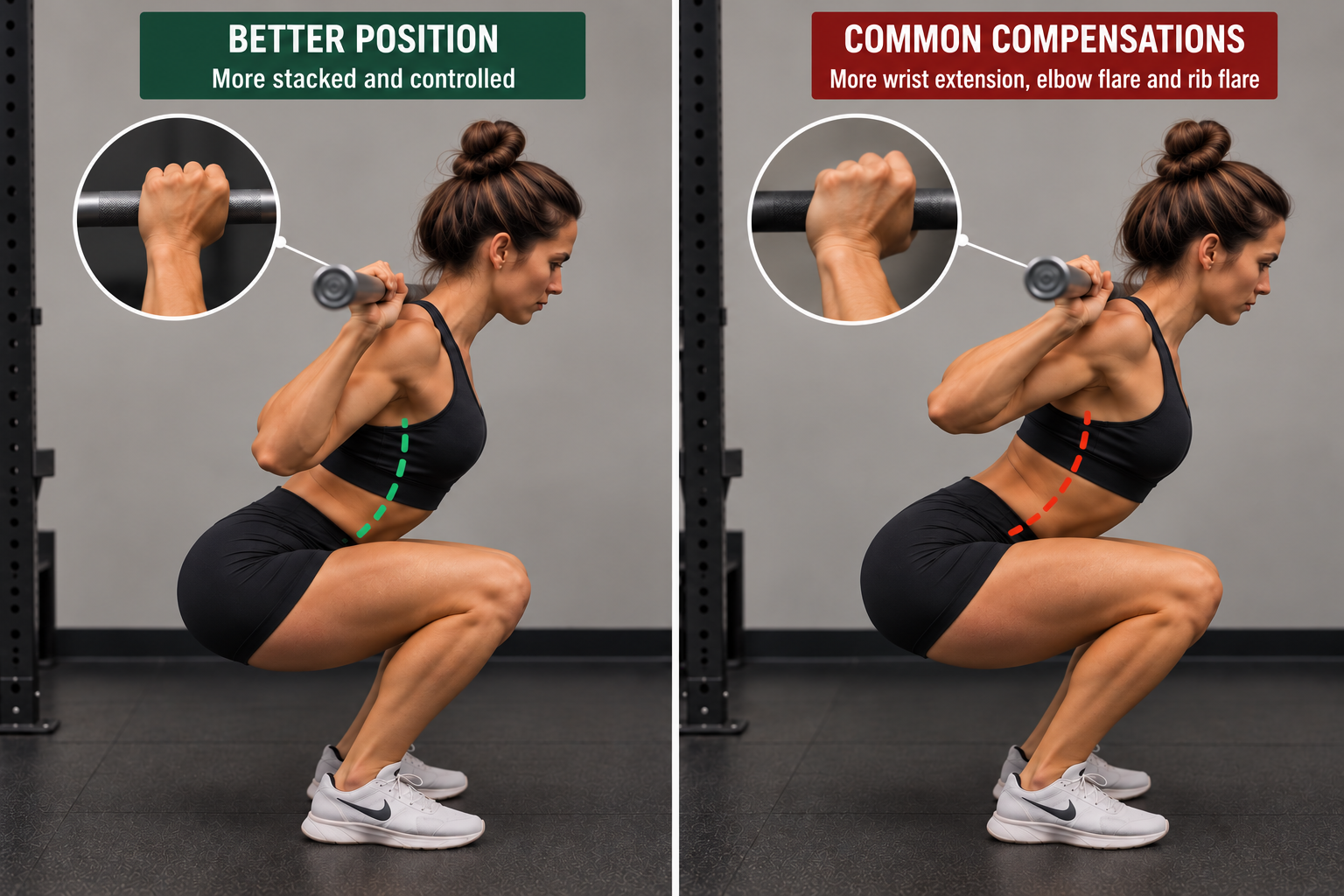
Another strategy lifters sometimes use to reach the bar is extending through the spine and allowing the front of the ribcage to flare upward.
Essentially, you're creating additional apparent range by changing the position of your torso rather than accessing all of the movement from the shoulder.
This is where the concept of stacking becomes useful.
At Avos Strength, we use "stack" to describe the relationship between the ribcage and pelvis. Rather than relying on excessive spinal extension and rib flare to create a position, we want the athlete to be able to access the movement they need while maintaining an effective relationship between the ribcage and pelvis.
Read more about this in our article, The Stack.
This doesn't mean forcing your ribs down or trying to remain perfectly rigid. The ribcage, spine and pelvis all need to move.
Instead, ask yourself:
Can I get my hands onto the bar without dramatically changing the position of my ribcage and spine to make it happen?
If you can access substantially more apparent shoulder motion only by extending your spine and flaring your ribs, that's useful information.
High Bar vs. Low Bar Matters
Where you put the bar changes the position you need to achieve.
In a high-bar back squat, the bar typically rests across the upper trapezius.
In a low-bar back squat, the bar sits farther down across the posterior shoulder and upper back.
Low bar generally requires a more demanding shoulder position because you have to reach farther behind yourself to secure the bar.
That distinction matters.
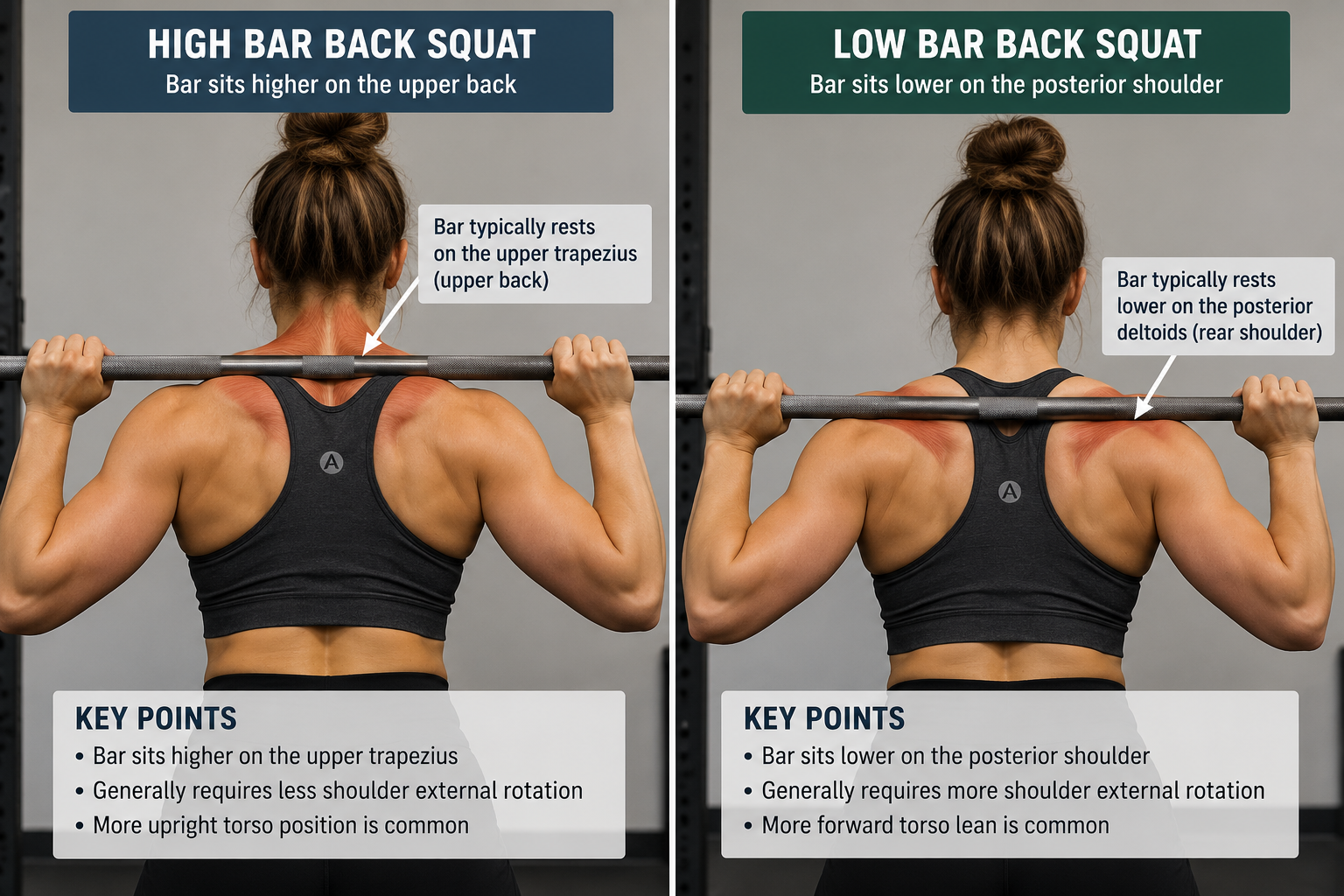
You may have enough shoulder mobility to comfortably high-bar squat but struggle to establish a low-bar position without excessive wrist extension, elbow flare or compensatory changes elsewhere.
If your wrists bother you during low-bar squats, trying a high-bar position may therefore be one of the simplest modifications available.
[VIDEO: High-Bar Back Squat]
Neither variation is inherently better. Your anatomy, mobility, training history and goals should help determine which one makes sense for you.
Start With Your Setup
Before deciding that you have a mobility problem, start with the simplest variables.
Try adjusting:
Grip width
Bar placement
Thumb position
Wrist position
Elbow position
Upper-back tension
A slightly wider grip may decrease the shoulder mobility required to reach the bar. A thumbs-over grip may feel more comfortable for some lifters. Changing the bar position can also substantially alter what is required from the shoulder.
Your elbows matter too, but there isn't one universally correct elbow angle.
The goal is to create a stable upper-back shelf and secure the bar without relying excessively on your hands and wrists to support it.
One useful cue is:
"Pull the bar into your back rather than holding it up with your hands."
Pay attention to what happens when you create tension.
If your elbows have to flare dramatically or your wrists are forced farther into extension simply to secure the bar, don't assume that you need a stronger cue. You may be reaching the limits of the position you currently have available.
A Simple Troubleshooting Process
If your wrists hurt during back squats, don't immediately assume you need more mobility. Start by watching what actually happens, ideally under load, since static, unloaded mobility can look fine even when the position breaks down as the weight goes up.
Look at your current squat.
When does the discomfort appear? Is it present with an empty bar or only under heavier loads? How extended are your wrists? Are your hands helping support the bar?Adjust the setup.
Experiment with grip width, thumb position, elbow position and bar placement.Compare high bar and low bar.
Does moving the bar higher allow you to establish the position more comfortably?Look at the shoulder and thorax.
Can you access the external rotation required without dramatically extending your spine or flaring your ribcage?Try an intervention and retest.
If posterior expansion or shoulder external rotation appears limited, use an appropriate drill and then immediately reassess the squat.
Did anything actually change?
Modify the exercise if necessary.
If you still can't comfortably establish the position, choose another squat variation while you work on the limiting factor.
This is much more useful than performing mobility exercises indefinitely without knowing whether they're actually changing the movement you're trying to improve.
You Can Still Squat Heavy
Not being able to comfortably hold a straight bar across your back doesn't mean you need to stop squatting. It means you may need a different way to load the pattern.
Safety Bar Squat
The safety squat bar allows your hands to remain in front of your body, substantially reducing the shoulder-position demands associated with a traditional back squat.
You can still load the squat heavily without forcing yourself into an uncomfortable upper-extremity position.
For someone who wants to continue using a posteriorly loaded squat while working on their shoulder or thoracic movement options, this can be an excellent choice.
Front Squat
Moving the bar to the front of the body removes the behind-the-body shoulder position required by the back squat.
A traditional front rack introduces its own mobility requirements through the shoulders, elbows and wrists, so it isn't automatically appropriate for everyone.
Using straps to hold the bar can modify the front-rack position when necessary.
Zercher Squat
A Zercher squat places the bar in the crooks of the elbows.
This removes both the behind-the-body shoulder position of the back squat and the traditional front-rack position of the front squat.
It isn't necessarily the right choice for everyone, but it demonstrates an important principle:
The squat is the movement pattern. The barbell back squat is simply one way of loading it.
In the meantime, you can work directly on what's limiting you, posterior expansion work, shoulder external-rotation exercises, or improving your ribcage-pelvis relationship as your arms move, while continuing to build lower-body strength with whichever variation fits your current position. Periodically retest the back squat. You may find your position improves and you return to it, or that another variation simply works better for you long-term. Both are fine outcomes.
When Wrist Pain Needs More Than a Squat Adjustment
Not every painful wrist during a squat is a positioning problem.
Previous injuries, local tissue irritation, and issues involving the wrist, elbow or shoulder can all contribute to symptoms.
If your wrist hurts outside of squatting, symptoms are worsening, you have swelling, numbness or tingling, you've recently injured the area, or modifying your squat has little effect on your symptoms, an assessment by an appropriate healthcare professional may be warranted.
Takeaways
Start with the simplest explanation: grip width, bar placement, wrist and elbow position, and how you're supporting the bar.
If adjusting your setup doesn't solve it, consider whether you can actually access the shoulder and thoracic position the exercise requires.
Some wrist extension isn't inherently a problem. If the position is comfortable, stable, and the bar is securely supported by your upper back, you don't need perfectly straight wrists.
If the position is painful or unstable, don't force it. Work on the specific movement options that appear limited, then retest the squat to see if anything actually changed.
Use a variation like the safety bar squat, front squat, or Zercher squat to keep training heavy while you work on the limitation, and periodically retest the back squat.
References
Kebaetse, M., McClure, P., & Pratt, N. A. (1999). Thoracic position effect on shoulder range of motion, strength, and three-dimensional scapular kinematics. Archives of Physical Medicine and Rehabilitation, 80(8), 945–950. https://doi.org/10.1016/S0003-9993(99)90088-6
Yoshimi, M., Maeda, N., Komiya, M., Fukui, K., Tashiro, T., Kaneda, K., Arima, S., Tsutsumi, S., Abekura, T., & Urabe, Y. (2022). Effect of thoracic expansion restriction on scapulothoracic and glenohumeral joint motion during shoulder external rotation. Journal of Back and Musculoskeletal Rehabilitation, 35(6), 1399–1406. https://doi.org/10.3233/BMR-220006