hypertrophy

Lactic Acid Isn’t the Bad Guy: What’s Really Behind Muscle Burn and Fatigue

Written by Evelyn Calado, MKin, CSCS, RKin


You’ve probably heard it before—“My legs are full of lactic acid,” or “It’s the lactic acid that makes me sore.”
But here’s the truth: lactic acid isn’t to blame for muscle soreness or fatigue—and in fact, it’s not even the enemy. It’s time to clear this up once and for all.

What Actually Happens During Exercise?

When you train—especially at moderate to high intensities—your body breaks down carbohydrates to produce energy. This process is called glycolysis, and it produces two main byproducts:

  • Pyruvate, which can be used to produce energy

  • Hydrogen ions (H⁺), which increase acidity in the muscle

Here’s the key thing to understand:

Hydrogen ions make your muscles feel acidic—not lactate.

As hydrogen ions build up, they lower the pH in the muscle (pH is a scale that measures how acidic or basic something is—lower pH means more acidic). This increased acidity can interfere with how your muscles contract and lead to that familiar burning sensation during hard efforts.

So What Is Lactate?

Lactate (often confused with “lactic acid”) is actually a helpful byproduct, not a waste product. When the rate of glycolysis increases and hydrogen ions start to accumulate, lactate is formed when pyruvate binds with those hydrogen ions.

This is a good thing. Lactate formation actually helps buffer the acidity by mopping up excess hydrogen ions. This slows down the drop in pH and helps you keep going longer.

So instead of being the villain, lactate is your body’s way of protecting itself from fatigue.

Myth-Busting: Lactate ≠ Muscle Soreness

Muscle soreness, especially the kind that shows up 24–48 hours later, is known as DOMS (Delayed Onset Muscle Soreness). It’s caused by microdamage to muscle tissue, inflammation, and the repair process—not by lactate.

The lactate-muscle soreness myth was debunked decades ago. Yet it continues to live on in gym talk, group classes, and even outdated training certifications.

We Produce Lactate All the Time

Contrary to popular belief, lactate isn’t just made during intense training. Your body is constantly producing and clearing lactate—even at rest.

It’s used as:

  • A fuel by the heart, brain, and slow-twitch muscle fibers

  • A precursor to glucose in the liver through the Cori cycle

  • A signaling molecule for adaptation and recovery

Far from being a waste product, lactate is essential to energy production and endurance performance.

Why Lactate Threshold Matters

Your lactate threshold refers to the highest intensity at which your body can produce and clear lactate at the same rate. Once you exceed that threshold, lactate begins to accumulate—but not because it’s causing fatigue. It’s a sign that your body is working hard and relying more on anaerobic metabolism.

What matters is that:

  • Lactate is a proxy for effort, not the cause of failure

  • The better trained you are, the more efficiently you can clear lactate, which allows you to sustain high output for longer

This is why aerobic base training and well-planned intervals are so valuable—they help improve your body’s ability to manage lactate and stay out of deep fatigue.

The Bottom Line

MythRealityLactic acid causes sorenessMuscle soreness comes from tissue damage, not lactateLactate makes you fatigueLactate buffers fatigue and helps you continueLactate is a waste productIt’s a valuable fuel and performance toolHigh lactate = badIt reflects effort—not failure

So next time you feel the burn or hear someone say “it’s the lactic acid,” you’ll know better: Lactate isn’t making you slow down—it’s helping you stay in the game.

Train. Play. Repeat.
Want to learn how to build your aerobic base, improve lactate clearance, and train smarter—not just harder? Book a session at Avos Strength and we’ll break it down.

How Long Does It Take to See Results From Training?

Written by Evelyn Calado, MKin, CSCS, RKin

Whether you're lifting to build muscle or grinding through cardio to boost your conditioning, it’s natural to ask: How long until I see results? The answer depends on the type of adaptation you're chasing—and how consistent you are.

This post breaks it down by phase:

  • Muscle strength and hypertrophy

  • Aerobic conditioning (aerobic base and VO₂max)

  • And how long it takes to lose your progress if you stop

Let’s dive into what the research says.

Strength & Muscle Gains: What Changes First?

Phase 1: Neural Adaptations (0–4 weeks)

In the first 2–4 weeks of strength training, most improvements come from neural adaptations. Your brain and nervous system get better at recruiting muscle fibers, stabilizing joints, and coordinating movement. You may lift more—but not because the muscle is larger.

📚 Research Insight: Moritani & deVries (1979) showed early strength gains are primarily neural. Hypertrophy starts later.

Phase 2: Muscle Hypertrophy (4–12 weeks)

Hypertrophy (muscle fiber growth) generally begins around week 4–6, with visible muscle changes occurring between weeks 6–12 depending on genetics, volume, nutrition, and training history.

📚 Schoenfeld (2010) found hypertrophy requires progressive overload, typically ~10+ working sets per muscle group per week for noticeable gains.

What’s a Reasonable Rate of Progress?

  • Beginners: 1–2 lbs of muscle per month is realistic (in a calorie surplus)

  • Strength Increases: ~2.5–5% increase in working weight every 1–2 weeks for major lifts is reasonable for novices

  • Progress slows for intermediate/advanced trainees; expect gains over months, not weeks


Conditioning: Aerobic Base and VO₂max

Building an Aerobic Base (Zone 2)

The aerobic base improves stroke volume, mitochondrial density, and fat utilization—especially through lower-intensity, longer-duration training (Zone 2).

  • Beginner Timeline: ~8–12 weeks of 3x/week Zone 2 sessions (~30–60 min) to build a meaningful base

  • Markers of Progress: Lower resting HR, improved repeatability, faster recovery between intervals

📚 Seiler & Tønnessen (2009): Elite endurance athletes spend ~80% of training in Zone 1–2, highlighting the importance of the aerobic base.

VO₂max Improvements

VO₂max is partly genetic—but also highly trainable, especially in untrained individuals.

  • Beginners: Can see a 15–20% increase in VO₂max within 8–12 weeks

  • Trained Individuals: Gains slow dramatically; might take years to improve VO₂max by an additional 5–10%

📚 Bouchard et al. (1999): Genetics account for ~25–50% of VO₂max variability, but training still plays a big role in untrained populations.

How Long Does It Take to Lose Gains?

The process of losing strength or conditioning is called detraining. It’s not instant—but it happens faster than most expect.

Muscle & Strength Loss

  • Strength: Maintained fairly well for ~2–3 weeks of no training

  • Muscle Size: Minor atrophy starts around 3–4 weeks of full rest

  • Total Deconditioning: ~8–12 weeks of inactivity can lead to noticeable reductions in strength and size

📚 McMaster et al. (2013): Power output and strength decrease more rapidly in trained individuals during inactivity.

Conditioning & VO₂max Loss

  • VO₂max: Can decline by 5–10% after just 2–4 weeks of inactivity

  • Endurance performance: Degrades faster than strength, especially in high-level athletes

  • Mitochondrial function: Begins to regress within a week or two

📚 Mujika & Padilla (2000): VO₂max can fall by ~20% within 8 weeks of full detraining.


Train smarter, not just harder. Results take time—and the key is consistency. If you want to build sustainable strength and conditioning, start with a plan that matches your level and lifestyle.

Need a program that does exactly that? Get in touch for custom training options tailored to your goals.

Protein for Lean Muscle Mass and Strength

Are you eating enough protein?

Most people, in particular athletes and active individuals do not consume enough protein.

Please note, that everyone is individual and I am providing information based on current research.  For specific recommendations based on your own needs, please consult a registered dietician (RD).

(And in my opinion if you are a vegan/vegetarian athlete I would highly recommend working with an RD to make sure you are consuming enough.)


How much protein should active adults/athletes consume?

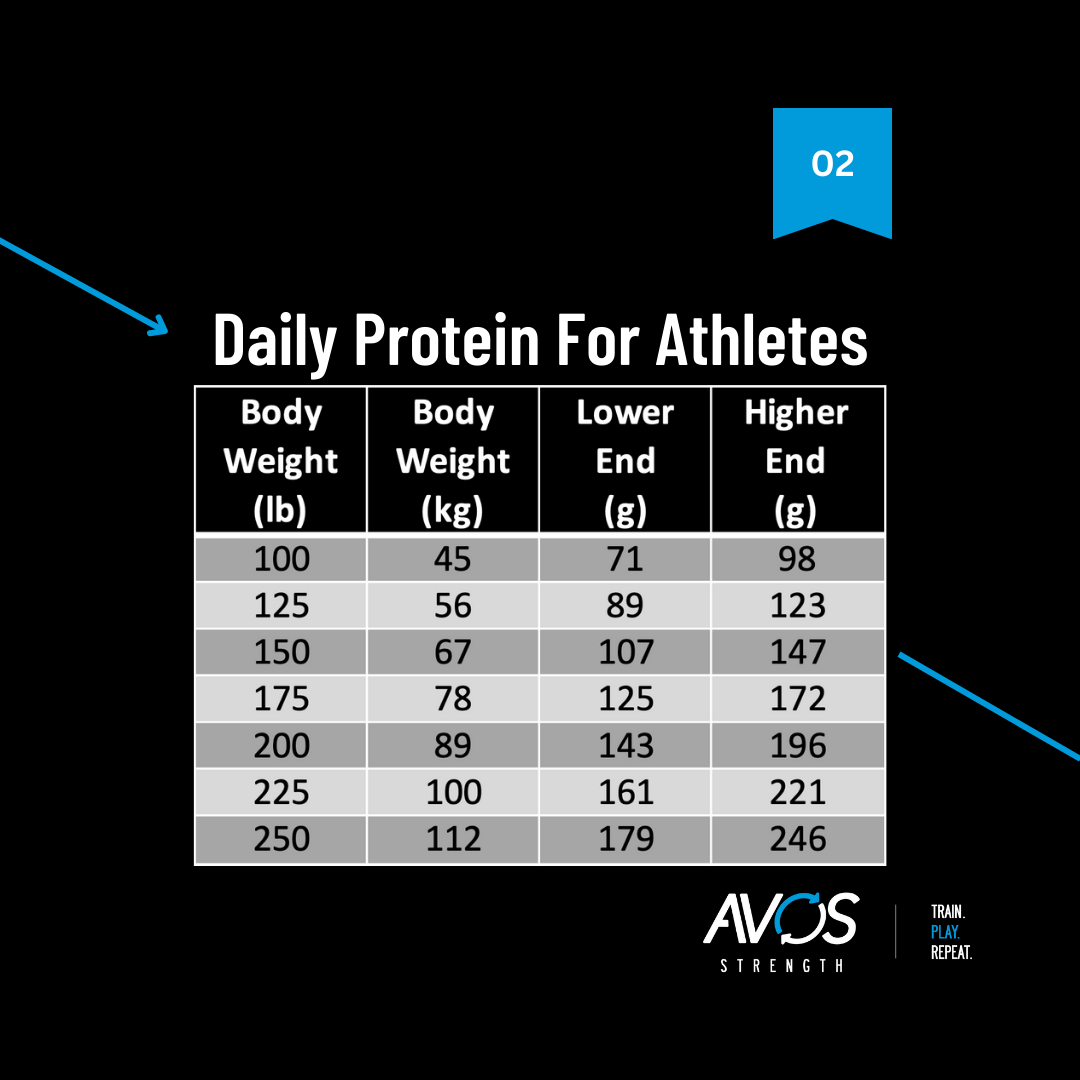
Active adults/athletes should consume 1.6 -2.2 grams/Kg/day spread across 4 or more meals/feedings.  This can be more or less depending on what your needs are.

Daily Protein Consumption for Athletes Based on Body Weight


How much protein should you eat per meal?

For maximal stimulation of muscle protein synthesis (MPS), individuals should aim for:

0.4–0.6 g/kg/meal of quality protein (found in meat, eggs, and dairy).

0.24 to 0.40 grams/kg/meal for most young adults

0.4 to 0.6 grams/kg/meal for older adults*


*Older adults need more protein due to muscle atrophy/sarcopenia - which is the progressive loss of muscle mass and strength. As you age it becomes harder to build muscle mass so you need to consume more protein to stimulate MPS.  (Ideally the additional protein should be paired with resistance training.)


 Can you eat too much protein?

It was previously thought that consuming an excess amount of protein would be wasted and excreted through your urine. However, that is from previous research 30+ years ago that believed that the increased amounts of nitrogen in urine was thought to be from excess protein consumption, in which case the protein was being wasted. This has since been refuted and the increased amounts of nitrogen actually represent an increase of the breakdown of your damaged or oxidized protein (which is a good thing - out with the old and in with the new!). Essentially, what is happening is that when you eat more protein, your body can replace more of its damaged or oxidized proteins, so that your protein synthesis (building) and breakdown are both increased.

 Therefore there is no downside to eating more protein (other than pushing you over your caloric goal if you are trying to be in a deficit). So have at her and let’s all eat some more protein!!

 References:

Morton RW, Murphy KT, McKellar SR, Schoenfeld BJ, Henselmans M, Helms E, Aragon AA, Devries MC, Banfield L, Krieger JW, Phillips SMA systematic review, meta-analysis and meta-regression of the effect of protein supplementation on resistance training-induced gains in muscle mass and strength in healthy adultsBr J Sports Med.(2018 Mar)

Moore DR, Churchward-Venne TA, Witard O, Breen L, Burd NA, Tipton KD, Phillips SMProtein ingestion to stimulate myofibrillar protein synthesis requires greater relative protein intakes in healthy older versus younger menJ Gerontol A Biol Sci Med Sci.(2015 Jan)

Morton RW, McGlory C, Phillips SMNutritional interventions to augment resistance training-induced skeletal muscle hypertrophyFront Physiol.(2015 Sep 3)

Schoenfeld BJ, Aragon AAHow much protein can the body use in a single meal for muscle-building? Implications for daily protein distributionJ Int Soc Sports Nutr.(2018 Feb 27)