
Written by Evelyn Calado, MKin, CSCS, RKin
If you’ve ever wondered why:
Your knees cave in at the bottom of a squat
Your low back extends when the weight gets heavy
One hip always feels “stuck” at 90°
Or mobility drills don’t seem to transfer to strength
…you’re probably running into a concept explained by the Limb Arc Model.
This model, commonly attributed to Bill Hartman, describes how rotational bias changes across ranges of joint flexion — particularly at the hip. And once you understand it, exercise selection becomes dramatically more logical.
Let’s break it down.
What Is the Limb Arc Model?
The Limb Arc Model proposes that rotational leverage changes as a joint moves through flexion.
At the hip specifically:
Early flexion favors external rotation (ER)
Mid-range flexion favors internal rotation (IR)
Deep flexion returns to an external rotation bias
This is not arbitrary. It reflects changes in joint geometry, length tension relationships, and moment arms.
Most people train hip flexion as if it is one continuous quality. It is not. It is three mechanically distinct regions.
That shift matters for:
Squats
Deadlifts
Split squats
Gait mechanics
Sport performance
Injury risk
The Hip Flexion Arc Explained
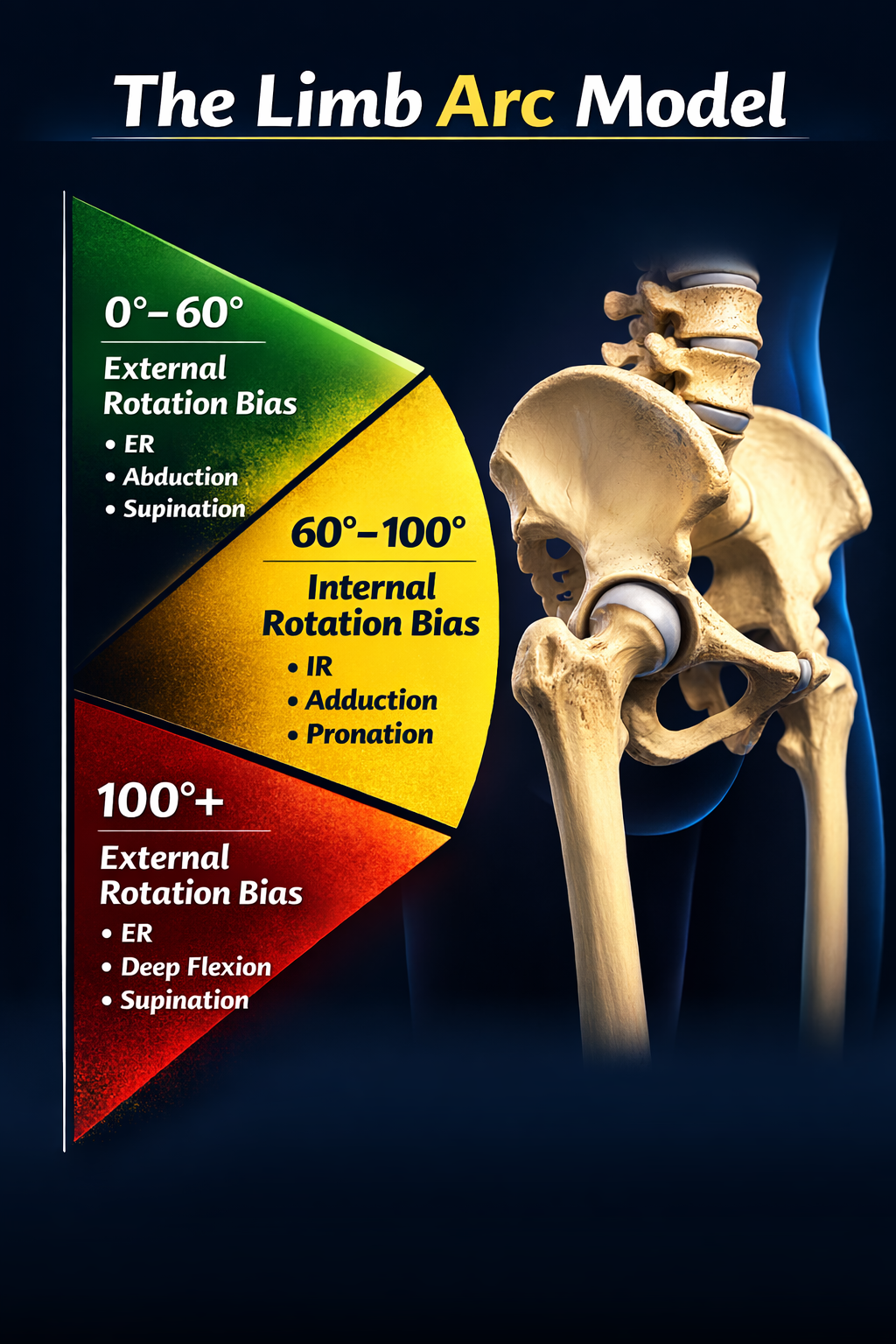
Here’s the simplified breakdown:
0–60° Hip Flexion → External Rotation Bias
In early hip flexion, the joint favors:
External rotation
Abduction
Supination at the foot
Sacral counternutation
In gait, this corresponds most closely with early stance, when the heel has contacted the ground and the pelvis is relatively externally rotating as load is being accepted.
In the gym, this is the top portion of a squat or the early phase of a hinge.
External rotators and abductors have favorable leverage here.
60–100° Hip Flexion → Internal Rotation Bias
Around 90° hip flexion:
Internal rotators and adductors have improved leverage
Length–tension relationships favor IR
The piriformis shifts moment arm toward IR
The sacrum moves toward nutation
The foot transitions toward pronation
In gait, this corresponds most closely with mid stance, when the pelvis is internally rotating on the femur and vertical ground reaction forces are highest.
In a squat, this is typically around parallel.
100°+ Hip Flexion → Returns to External Rotation Bias
As you approach deep hip flexion:
The system transitions back toward ER
Supination strategies often reappear
External rotators regain leverage
This helps explain why some people feel “better” deep in a squat even if they struggle at parallel. They are returning to a range where external rotation leverage increases again.
Why Internal Rotation at 90° Matters
Most loaded bilateral lower-body exercises demand control around 60–100° hip flexion.
If internal rotation is limited in that range, common compensations show up:
Knee valgus
Lumbar extension
Butt wink
Hip shifting
Over-pronation
Gripping with toes
This is not always a strength problem.
It’s often a relative motion problem.
The joint is being asked to produce force in a range it does not control. When the femur is not internally rotating relative to the pelvis, the pelvis, spine, or foot moves instead.
“Train within the Range You Own”
Here’s where this becomes practical.
Owning a range means:
You can access it
You can control it
You can breathe in it
You can maintain joint relationships without compensating
If you lack IR at 90°, loading it heavily won’t fix it.
It may:
Reinforce compensations
Drive orientation strategies (like anterior pelvic tilt)
Increase compressive strategies instead of restoring motion
Instead, you might need:
Split squats that bias mid-stance
Exercises emphasizing medial arch contact
Internal rotation control drills
Breathing-based repositioning work
Heel references to restore early stance mechanics
Force production should follow motion restoration — not precede it. Ie; Restore control first. Then add load.
How This Applies to Programming
The Limb Arc Model gives you a filter for exercise selection.
The question is not whether someone “has internal rotation.”
The question is where in the arc they lose control.
If Control Breaks Down Between 0 and 60 Degrees
You will see:
Difficulty accepting load at the top of the squat
Poor heel contact
Immediate external rotation gripping
Early lumbar extension
In this case, reinforce early stance mechanics.
Use closed chain drills that emphasize heel reference and controlled external rotation.
Keep the hip in the zero to sixty degree range and teach load acceptance without extension strategies.
The goal is stable external rotation control in early hip flexion.
If Control Breaks Down Between 60 and 100 Degrees
You will see:
Knee valgus at parallel
Hip shift at ninety degrees
Lumbar extension at the sticking point
Loss of medial arch control
This is the most common presentation.
Here, you bias time spent in sixty to one hundred degrees of hip flexion in closed chain.
Split squat variations are useful when organized correctly because they allow:
Pelvis on femur relative motion
Clear stance leg reference
Control of hip flexion angle
Moderate load that does not overwhelm internal rotation capacity
The key is managing support and load so that the pelvis can internally rotate on the femur without defaulting into orientation strategies such as anterior pelvic tilt or lateral shift.
This is not about making someone balance harder.
It is about placing them in the internal rotation biased window and allowing them to control it.
If Control Breaks Down Beyond 100 Degrees
You will see:
Instability or collapse in deep squat
Over reliance on passive structures
Loss of tension in the bottom
In this case, gradually expose the athlete to deeper flexion under controlled conditions, restoring external rotation leverage without compensatory lumbar flexion.
Why This Model Is Powerful
The Limb Arc Model connects:
Gait
Breathing mechanics
Pelvic motion
Squat depth
Performance
Compensation patterns
It explains why:
One depth feels strong and another feels unstable
Deep squats don’t fix mid-range weakness
“Mobility” doesn’t always transfer to strength
Because leverage changes as joint angles change.
And if you don’t own the transition between those zones, the body will compensate.
Final Takeaway
The Limb Arc Model isn’t about stretching more.
It’s about understanding that:
Rotational demands shift as joints move through flexion.
And if you load a range you don’t own, your body will borrow motion from somewhere else.
Train the range you control.
Then expand it.
That’s how you build durable strength.
Learn more about how we assess movement and build individualized programs at Avos Strength.